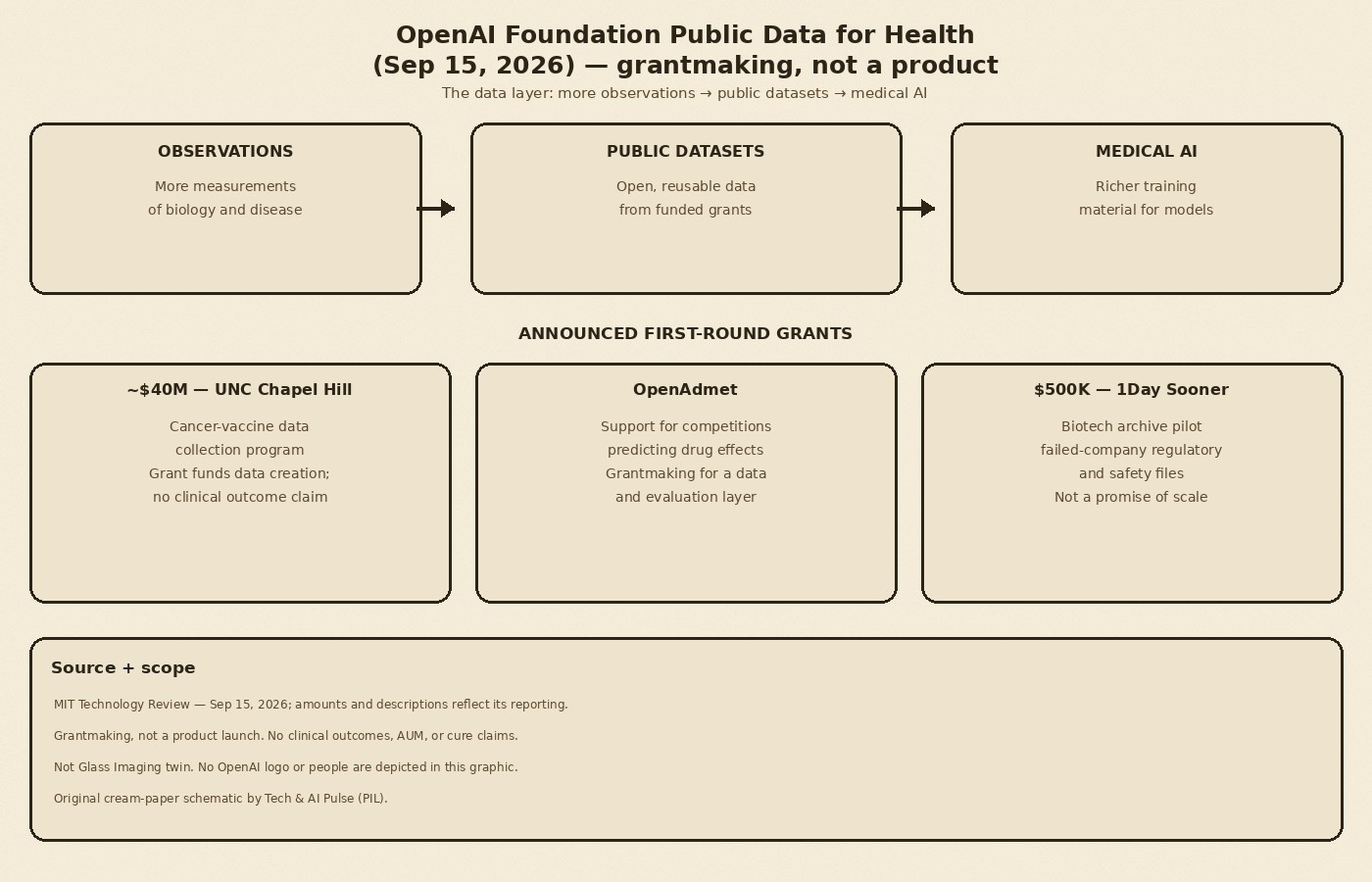
From Mexico — this isn’t another OpenAI product ship, and it’s not a twin of the Glass Imaging acquisition chatter. MIT Technology Review reports the OpenAI Foundation — the nonprofit parent — is funding a grantmaking effort called Public Data for Health: pay to create high-quality scientific and biology datasets so medical AI has more to learn from.
The frame from the Foundation, via Technology Review: remaining breakthroughs in preventing and curing disease need pairing smarter models with more observations of the world — more data. Morgan Levine (former Altos Labs VP for computation) puts the bottleneck bluntly in the same piece: data is the biggest constraint when applying AI to biology.
First-round grants — UNC, OpenAdmet, 1Day Sooner
I’m sticking to the first-round grants Technology Review names. No invented clinical outcomes, no foundation AUM math, no cure claims.
Per Technology Review: ~$40M to UNC Chapel Hill for a program collecting data about novel cancer vaccines. OpenAdmet support — a group that runs competitions where researchers try to predict drug effects. And $500,000 to 1Day Sooner (an advocacy group for clinical-trial volunteers) to pursue Ruxandra Teslo’s “biotech’s lost archive” idea: salvage detailed regulatory and safety files from failed biotech companies that usually stay trade secrets.
1Day Sooner’s $500K biotech archive pilot
Per Technology Review, Teslo argued those bankruptcy-era common technical documents — regulator back-and-forth plus scientific measurements — could train AIs as copilots for an opaque drug-approval process. 1Day Sooner’s Josh Morrison says the $500K helps prove they can obtain those troves; the group already holds three datasets (two donated by Lumen Bioscience in the reporting). Two other bids this year weren’t accepted. That’s the sourced status — not a guarantee the archive scales.
My takeaway
From Mexico, the narrow read: Public Data for Health is Foundation grantmaking for biology datasets — UNC cancer-vaccine data (~$40M), OpenAdmet, and a $500K biotech-archive pilot at 1Day Sooner — because models still starve for real observations. I’m not pacing Altman IPO chatter or safety-coordination theater here; this piece is about paying for the data layer. Source: MIT Technology Review.