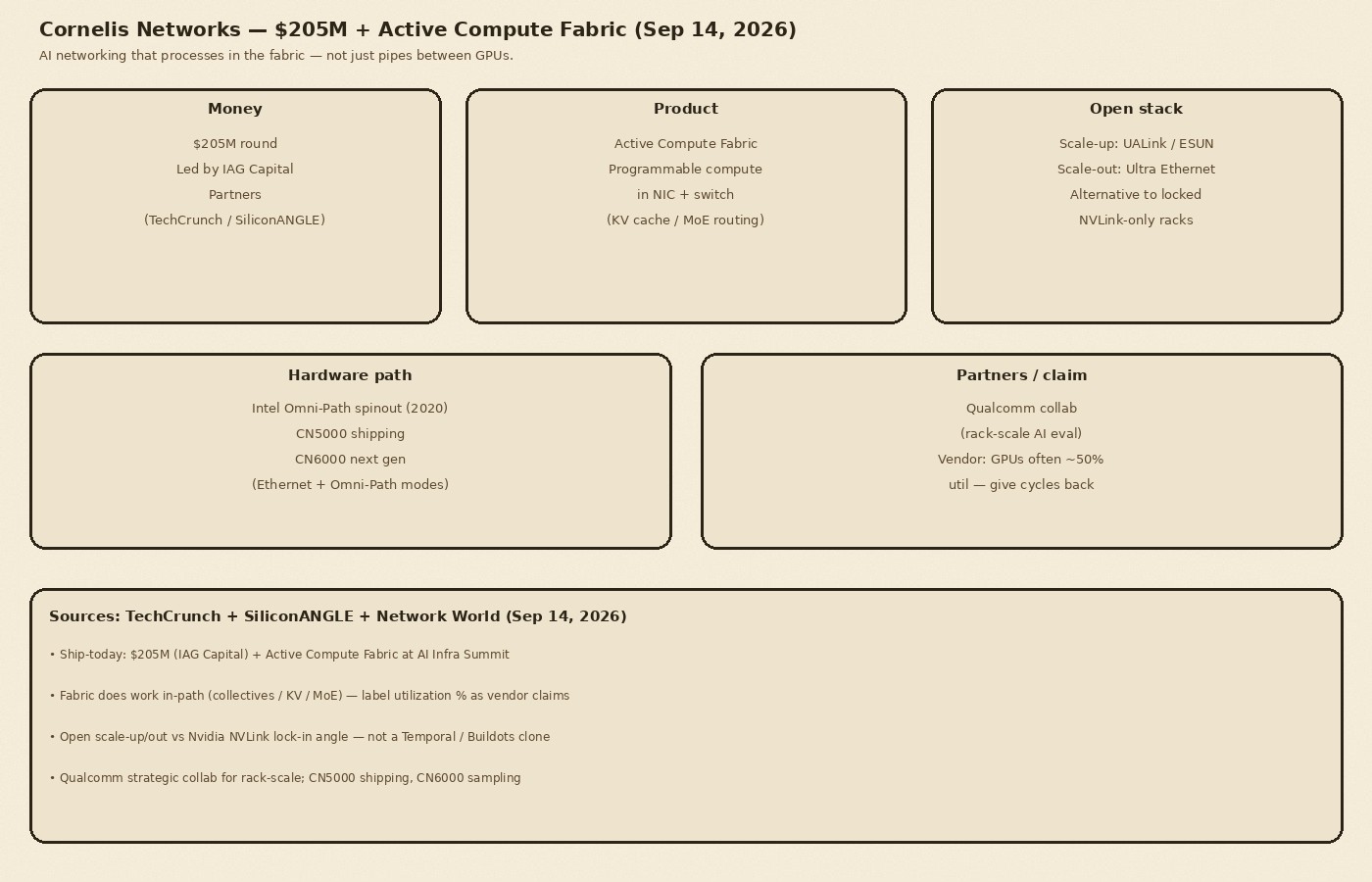
From Mexico — most AI infra headlines are about bigger GPUs. Today’s TechCrunch piece is about the other bottleneck: the network that feeds them. Cornelis Networks announced a ~$205 million round led by IAG Capital Partners, plus a new architecture it calls Active Compute Fabric.
I’m reading this as a ship-today story: money, product, and a Qualcomm collaboration landed together on Sep 14. Not a “chip race” essay.
What Active Compute Fabric actually is
Per SiliconANGLE and Network World, Cornelis wants the fabric to do work while data is in transit — not just forward packets. Think KV-cache assembly for disaggregated inference, mixture-of-experts routing, and collective ops like AllReduce happening inside the path.
Network World quotes CEO Lisa Spelman on putting real compute — licensed RISC-V cores — into both the NIC and the switch, beyond a typical smart-NIC/DPU offload. CMO Brandon Draeger told SiliconANGLE the payload “does not arrive the way it left.”
Open scale-up / scale-out — and the Nvidia angle
TechCrunch frames Cornelis as an open-architecture play: customers can mix GPU/accelerator hardware instead of living inside one vendor’s full stack. SiliconANGLE says the fabric leans on open standards — UALink and ESUN for scale-up, Ultra Ethernet for scale-out. Spelman told Network World the scale-up push targets compute that doesn’t want to be locked to Nvidia’s NVLink ecosystem.
Company lineage matters for context: Cornelis spun out of Intel in 2020 from the Omni-Path team. CN5000 is shipping; the next-gen CN6000 adds Ethernet modes and is sampling toward availability later this year, per the same reporting.
Qualcomm + the utilization claim (label it)
Alongside the raise, Cornelis announced a strategic collaboration with Qualcomm Technologies aimed at rack-scale AI networking — joint tech evaluation for inference across scale-up and scale-out, per SiliconANGLE.
On utilization: Spelman and Draeger talk about accelerators often sitting near ~half capacity while they wait on the network, and “giving you your GPUs back.” Draeger also cited pre-production sims with up to ~50% less network traffic. Those are vendor claims — I’m not treating them as independent benchmarks.
My takeaway
From Mexico, the narrow read: Cornelis just stacked a $205M IAG-led raise with Active Compute Fabric — networking that processes AI traffic in-path — plus a Qualcomm rack-scale collab and an open scale-up/out story versus NVLink lock-in. Sources: TechCrunch, SiliconANGLE, Network World.