
Google DeepMind launched agentic video understanding today across Gemini 3.7 Flash, 3.6 Flash, and 3.5 Flash-Lite. Instead of chewing a clip at a fixed frames-per-second rate, the model can search and scan the parts it needs — visual frames, audio, and transcript — and fetch those on demand.
That’s live now for video uploads and YouTube through the Gemini API in Google AI Studio and the Gemini Enterprise Agent Platform. Standard token pricing. No extra feature fee. Flip it on with processing: "agentic" (docs also show media_processing: "AGENTIC").
Static ingest was the expensive default
Google’s post is blunt: static processing samples at a fixed FPS — default 1 FPS, adjustable in the API — so you pay for frames whether they answer the question or not. On long how-tos, lectures, and multi-hour recordings, that forces a bad trade: huge token bills or techniques that drop detail.
Cloud docs for Gemini Enterprise Agent Platform describe the same idea: agentic mode lets the model navigate video dynamically instead of processing every frame statically. You can even mix agentic and static modes across different videos in one request.
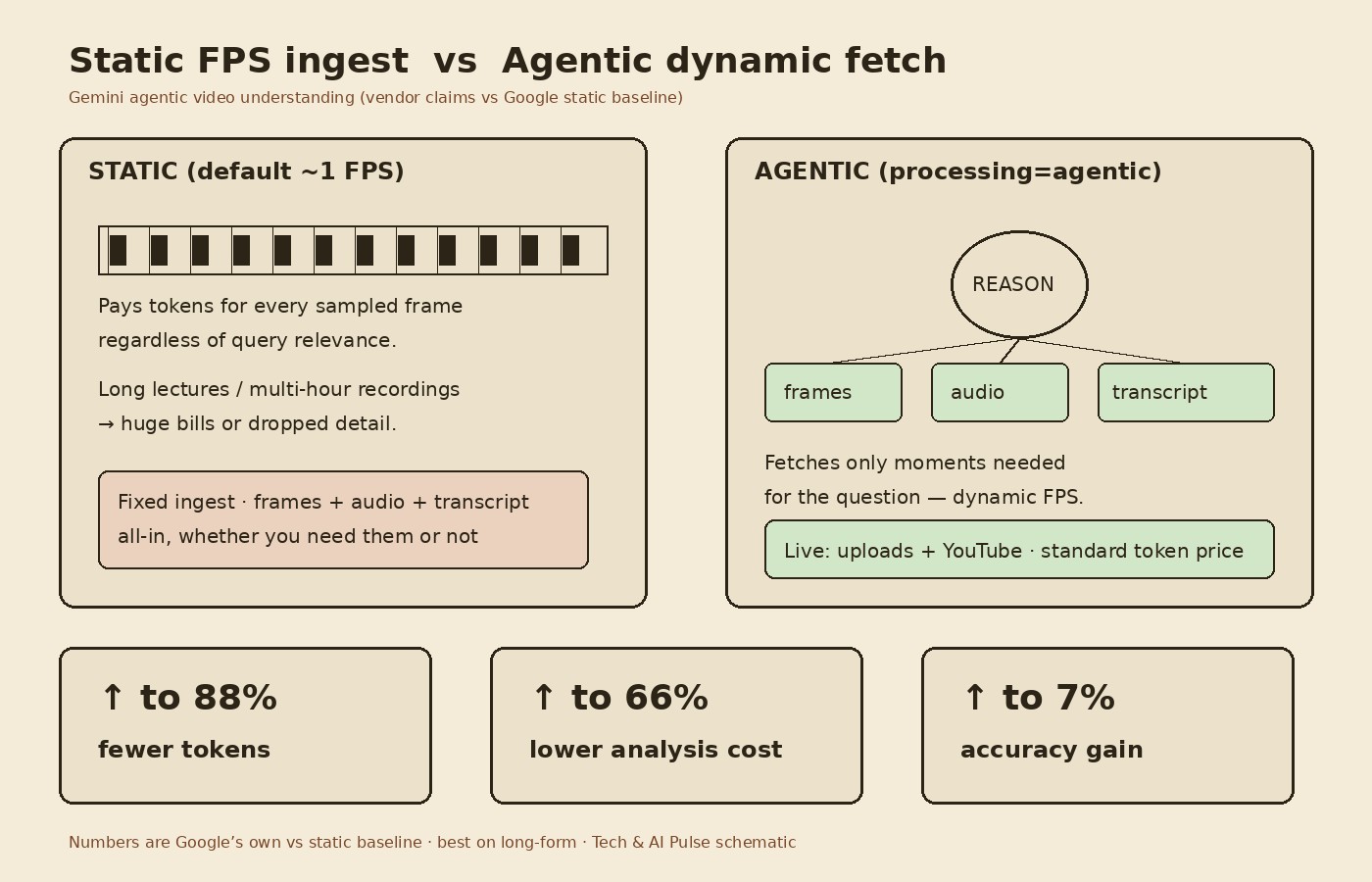
Vendor numbers — label them as such
Google’s own benchmarks vs its static baseline claim up to 88% fewer tokens, up to 66% lower analysis cost, and up to 7% better accuracy. Gains are strongest on long-form. Gemini 3.7 Flash with agentic mode is positioned as the quality/cost sweet spot among the three. Those are vendor figures — not an independent audit. “Up to” does real work here.
FourWeekMBA’s read frames the story as a cost print more than a new frontier model: production Flash models, cheaper video unit economics, consumer Gemini app and Ask YouTube still coming. Blockchain.News echoes the same launch surface and the same percentage claims.
What you can actually ask for
Google lists the practical jobs: sub-second moment retrieval for tight cuts, long-form needle-in-a-haystack search without burning millions of tokens, anomaly detection by resampling hot windows at higher FPS, and counting actions or objects over time. Supported agentic sources include YouTube URLs, Cloud Storage URIs, and inline base64 video. Docs note agentic video understanding is Preview and currently on the v1beta1 path for GenerateContent.
Coming soon, per Google: the Gemini app for everyday users, and later an Ask YouTube experience on the watch page. What’s shipping today is the developer and enterprise API surface.
Why I care from Mexico
From Mexico, I’m less interested in another demo reel and more in whether long video stops bankrupting a side project. Lecture dumps, support call recordings, local event footage — that stuff only becomes a product when the token math works. If agentic mode really cuts the bill on Flash, more builders here can ship video agents without waiting for a grant. I’ll still treat the 88% / 66% / 7% stack as Google marketing until I run my own clips.
Hero image: turned-on projector photo by Jeremy Yap on Unsplash (Unsplash License). Cropped and color-graded by Tech & AI Pulse.