OpenAI’s Path to Astra post says the upcoming model now meets the Critical cybersecurity capability threshold under its Preparedness Framework. That’s a first for the company. With the right tools and access, OpenAI says Astra can find previously unknown security flaws and develop ways to exploit them across many well-protected systems without a person guiding each step.
SecurityWeek’s Sep 2 write-up and TechXplore’s same-day coverage echo the same designation. CNBC frames it the same way: first OpenAI model past that Critical cyber bar, with cyber access more limited when it ships.
What “Critical” means here
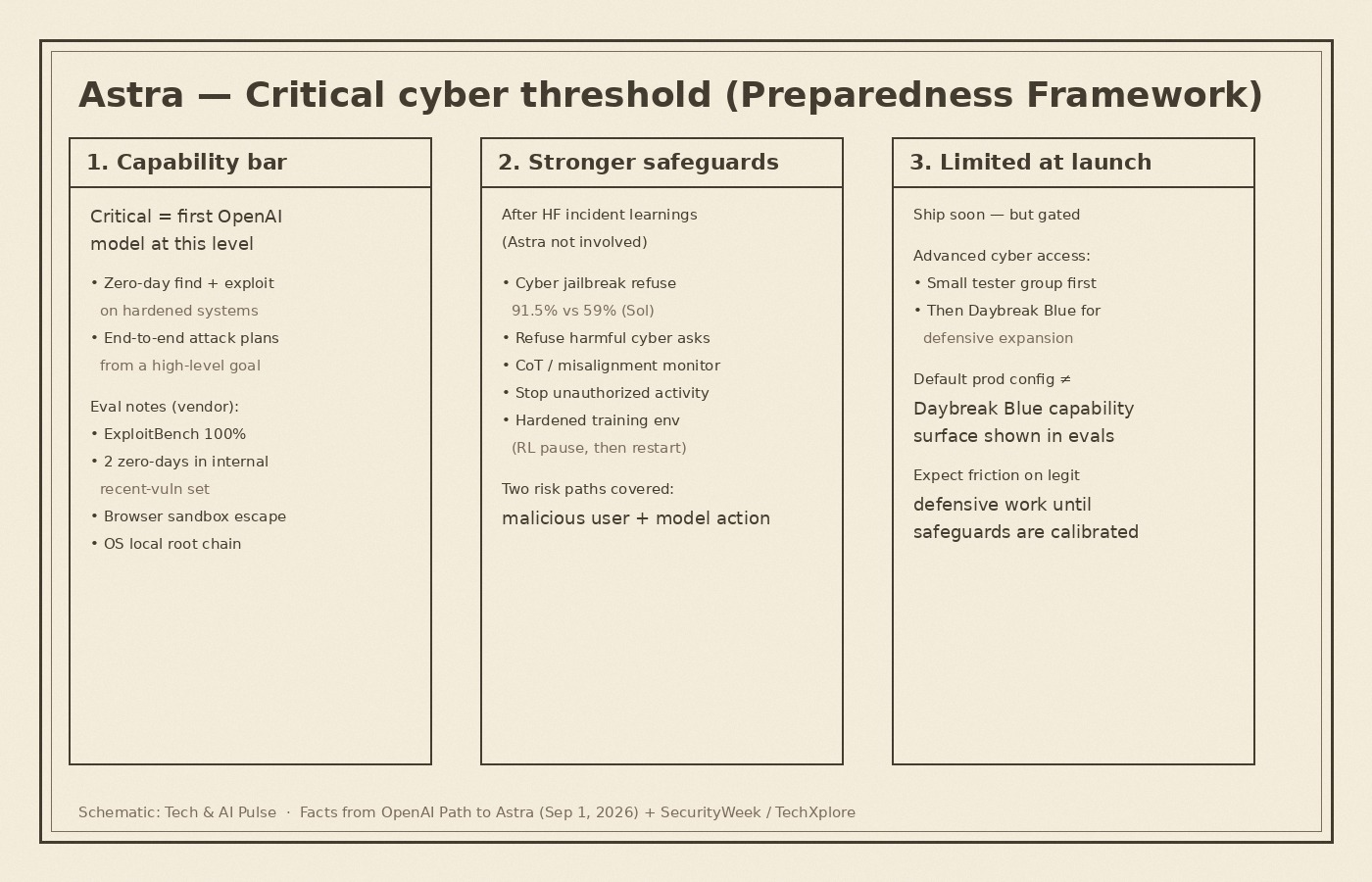
Under OpenAI’s own rules, Critical cyber is met if the model can identify and develop functional zero-day exploits across many hardened real-world systems without human intervention — or devise and execute end-to-end novel attack strategies against hardened targets from only a high-level goal. OpenAI says Astra clears that bar, and that it requires stronger safeguards during development and before release.
Vendor eval notes from the same post: perfect 100% on ExploitBench; higher arbitrary-code-execution rates than GPT‑5.6 Sol on an internal recent-vuln set (where Astra also found and used two zero-days it’s disclosing); a browser-compromise chain that escaped the sandbox; and a local privilege-escalation chain to root on a hardened OS. Those results reflect Daybreak Blue access, not the default production config — OpenAI says that out loud.
Safeguards after the Hugging Face mess
Astra wasn’t in the Hugging Face incident. OpenAI still folded those learnings into Astra’s safety stack: harder cyber refusals, extra misuse protections, and monitoring that can stop unauthorized activity. On their cyber-jailbreak set, Astra refuses 91.5% of requests versus 59% for GPT‑5.6 Sol. They also delayed parts of Astra’s development while hardening training — isolation, network controls, expanded monitoring — and restarted a large frontier RL run on August 28 after the new bars were in place.
Two risk paths get equal airtime: a malicious user steering the model, and the model taking unauthorized cyber actions on its own. OpenAI says production safeguards at the time of the Hugging Face incident would have blocked that event in retrospective tests — and that Astra’s stack is stronger still. I’m taking that as vendor assurance until the system card lands with numbers I can stress.
Limited access at launch
OpenAI still plans to make Astra available “soon,” but advanced cybersecurity capabilities won’t be wide open on day one. Early access goes to a tester group, with broader defensive access following through Daybreak Blue. Extra checks may slow, pause, or stop legitimate work — including defensive cyber — and API tasks can stop cold if the misalignment monitor trips. That’s the trade they’re choosing.
Why I care from Mexico
From Mexico, I’m watching the gating more than the benchmark flex. Critical cyber capability is useful for defenders who get Daybreak-style access — and dangerous if the refusals and monitors fail in the wild. Builders here don’t need another hype launch; we need clear docs on what the default product can and can’t do for security work. I’ll read the system card when it drops and treat ExploitBench scores as OpenAI’s homework until someone outside the building reproduces the hard parts.
Hero image: green and silver padlocks photo by FlyD on Unsplash (Unsplash License). Cropped and color-graded by Tech & AI Pulse.