Anthropic released Claude Fable 5.1 and Claude Mythos 5.1 today. They’re the same underlying model with different safeguard levels. Fable is generally available. Mythos stays behind trusted-access programs for cybersecurity and life sciences.
The headline isn’t only another benchmark chart. TechCrunch’s write-up and VentureBeat’s breakdown both land on the same practical point: Anthropic is trying to make long-running agents cheaper and less annoying to run inside a company.
What actually shipped
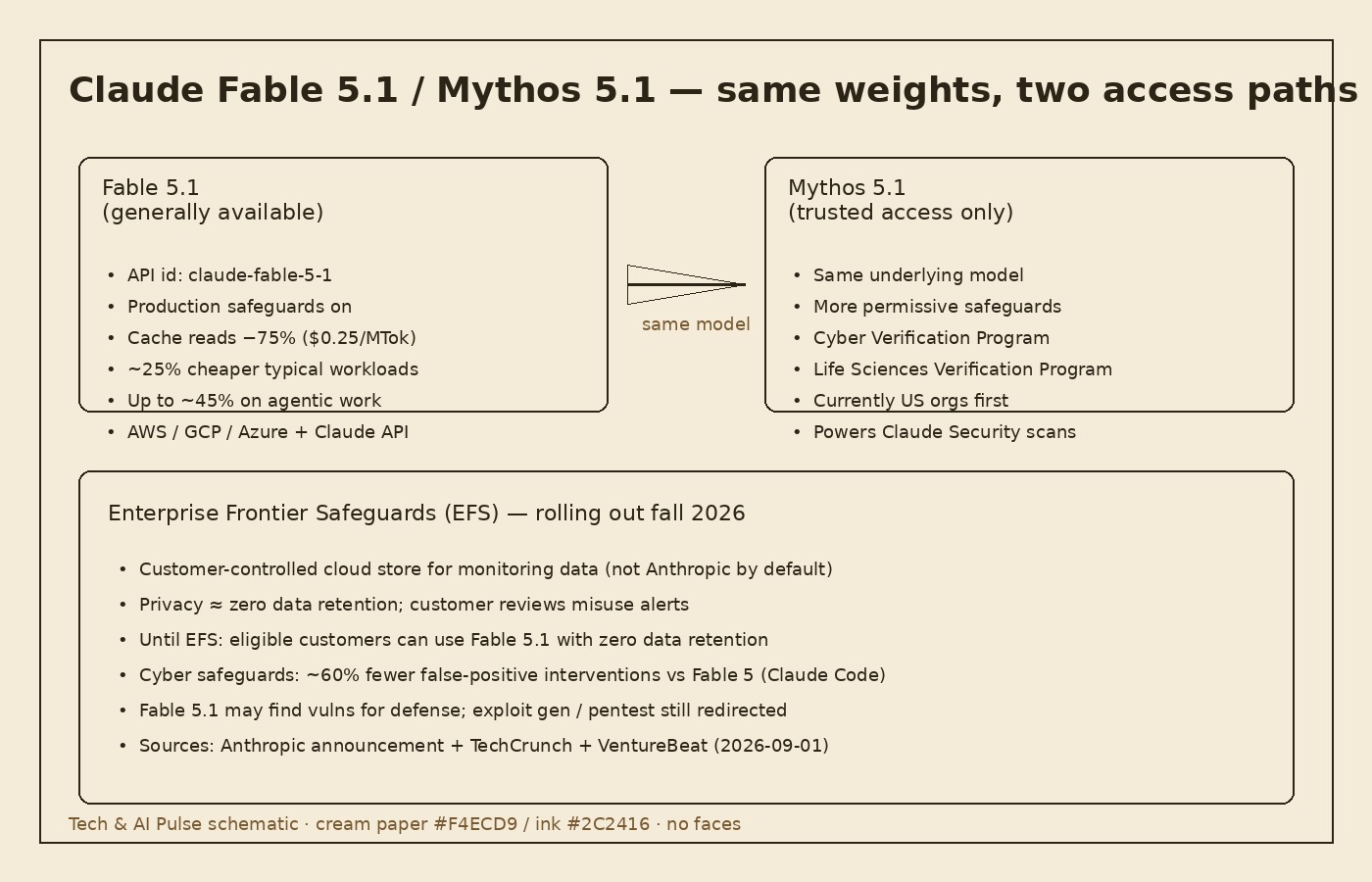
Developers can call claude-fable-5-1 on the Claude API, and Anthropic says the same model is live across AWS, Google Cloud, and Microsoft Azure. The platform docs list Fable 5.1 as active, released September 1, 2026.
Base token prices stay premium: $10 per million input tokens and $50 per million output, same as Fable 5. The change that matters for agents is cache reads. Anthropic cut cache-read pricing by 75%, down to $0.25 per million tokens. It estimates about 25% lower cost on typical workloads and up to about 45% on highly agentic ones, because those jobs keep re-reading the same context.
Mythos is the same brain with a looser lock
Anthropic is explicit: Mythos 5.1 is identical to Fable 5.1, but with more permissive safeguards for vetted cyberdefenders and life-sciences researchers. Access runs through the Cyber Verification Program and the Life Sciences Verification Program. For now, Mythos is limited to a set of U.S. organizations, with expansion coordinated with the U.S. government.
On Fable itself, Anthropic says cyber safeguards create around 60% fewer interventions per Claude Code session than Fable 5’s earlier filters. The model can help find software vulnerabilities for defense. Exploit generation, penetration testing, and some binary scanning still get redirected.
Privacy: keep the logs on your cloud
The other enterprise piece is Enterprise Frontier Safeguards (EFS). Monitoring data can live in customer-controlled AWS, Azure, or Google Cloud infrastructure. Automated misuse detection still runs, but human review defaults to the customer, not Anthropic. EFS rolls out in phases this fall. Until then, eligible customers can use Fable 5.1 with zero data retention.
TechCrunch notes that Anthropic also restated it has never trained on enterprise data without explicit permission.
Benchmarks and science demos — treat as vendor claims
Anthropic reports Fable 5.1 at 55.8% on Terminal-Bench 4.0 (Mythos 5.1 at 60.9% under more permissive cyber settings), 52.6% on Terminal-Bench-Science 0.1, and 73.4% on CursorBench 3.2.0. Those are company numbers with footnotes about safeguards intervening on some tasks. Useful signal. Not an independent audit.
The research demos are flashy: Mythos-designed protein binders validated in labs, a higher-resolution Venus elevation map from Magellan radar, and GPU kernel optimizations that sped up open-source biology models. Again, that’s Anthropic’s own release material. Interesting if true at scale. Still not a substitute for outside replication.
Why I care from Mexico
From Mexico, I’m watching the cost curve more than the scoreboard. Long agent sessions die on cache bills and false-positive blocks. If Fable 5.1 really cuts those two frictions, more shops will leave a frontier model running overnight instead of babysitting Opus-class traffic. Mythos stays invite-only for a reason — capability and risk travel together. I’ll try Fable on real coding work before I trust the “world’s most advanced” line.
Hero image: server racks photo by Taylor Vick on Unsplash (Unsplash License). Cropped and color-graded by Tech & AI Pulse.