
Here’s a number that stopped me this morning. Cloudflare says that in March 2026, AI agents were responsible for a quarter of all Wrangler usage, up from single digits the year before. And last week? 48%. That’s from the Cloudflare blog post launching cf, published today, Sep 28. They describe the new tool as “the agentic CLI for the entire Cloudflare API.” When almost half your CLI traffic comes from agents, you stop designing for the person at the keyboard and start designing for the agent that person is steering.
What cf actually changes
Cloudflare’s own numbers explain why. Agents, they write, “are more prolific users, using almost twice as many distinct commands per day, and are almost four times as likely to use six or more commands.” But Wrangler only covers around 280 operations, while Cloudflare’s API has thousands. So cf, now in open beta (npm i -g cf), is meant to cover the entire API surface, over 3,000 operations. The design choices are the part I’d steal for my own tools:
- JSON by default. Output is “pretty printed for humans and condensed for agents for maximum context savings.” Their reasoning is blunt: “agents just need JSON, and if agents are the future primary user of this tool, it should be the default.” No more agents tacking
--jsononto every command and piping throughjq. - Command discovery in plain language. With 3,000+ routes, you can’t dump the whole help tree into context.
cf cli searchlets the agent describe what it wants in natural language, and a small search index returns matching commands. The CLI tells the agent about it the first time it runs--help. - Typed configuration.
cloudflare.config.tsreplaces TOML/JSONC with TypeScript, so your agent’s language server can actually check the config. Cloudflare says some internal Wrangler configs of over 5,000 lines shrank by 40%. - Vite as the default dev server and build path, with
cf migrateto move existing Workers over.
One detail I really like: the launch post includes a copy-paste prompt that asks your coding agent to add cf guidance to its own global instructions file. That’s docs written for the agent, not only for you. Cloudflare’s argument is that a brand-new CLI is actually less confusing for agents than a big change to a tool they’ve already memorized from years of training data.
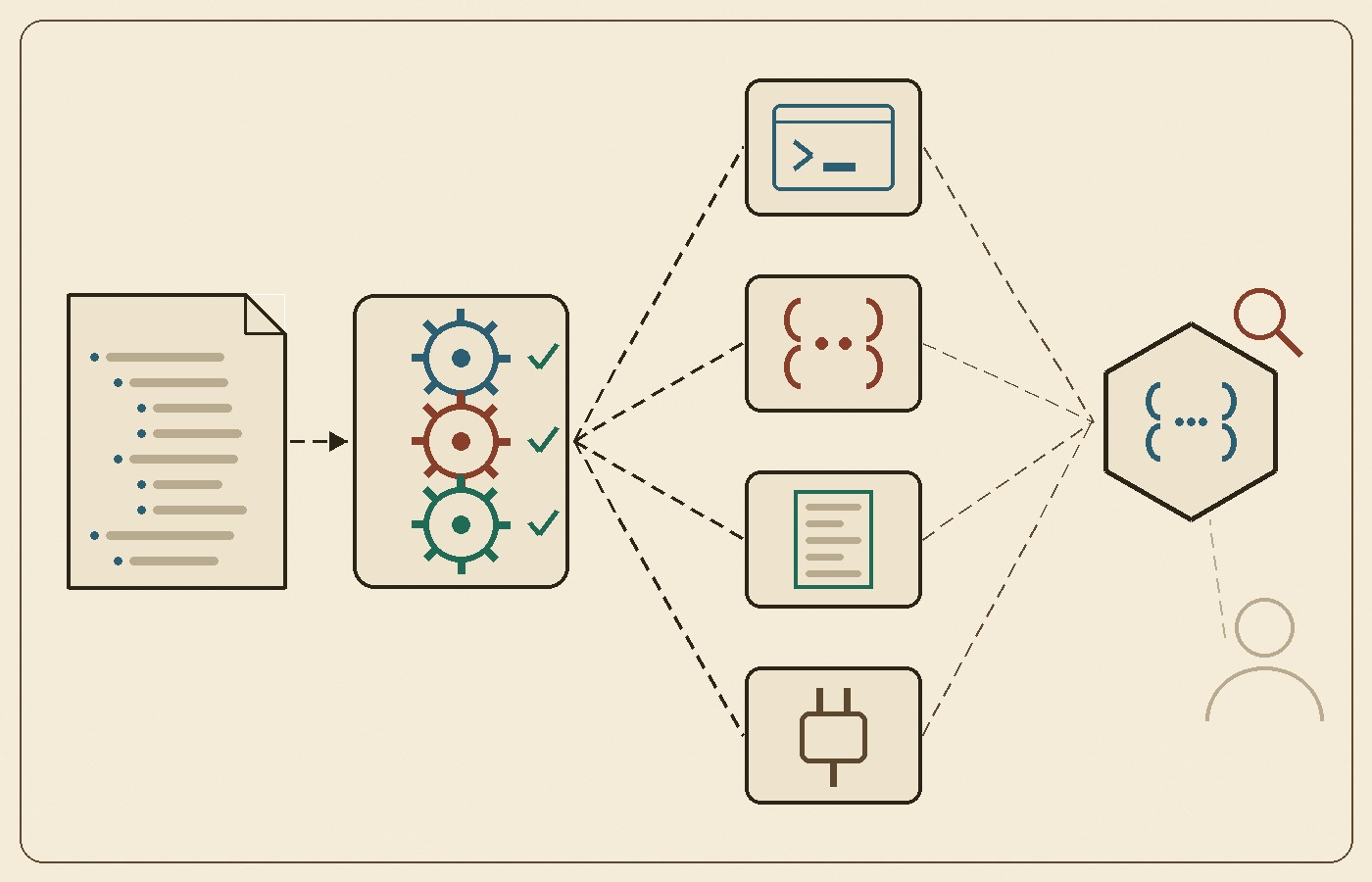
Forge: the generator underneath
Nobody hand-writes 3,000 commands. In a companion post, Cloudflare introduces Forge, “an open source, pluggable generation pipeline that anyone can deploy and run for free.” It takes OpenAPI definitions today (it’s designed to accept formats like AsyncAPI, GraphQL, and Protobuf in the future) and generates the CLI, SDKs, and docs. You can chain targets, so one generated output feeds the next. It runs in CI on each team’s API repo, lints every change, and builds installable previews of the CLI, SDKs, and docs before anything merges.
The line that sums it up: “We built Forge because we needed it ourselves in order to treat agents as our customers.” They also admit they tried hosted generators, relied on some in production, and “some have shut down entirely.” So Forge is on GitHub under Apache 2.0, and you can run it privately, modified, for free. They’re upfront that it’s early: Forge already generates what cf needs, and Cloudflare says it’ll power their API docs and SDKs over the next few months.
What happens to Wrangler
No rush, but the direction’s clear. Workers that still depend on Wrangler’s esbuild setup keep delegating builds to Wrangler for now. When the open beta ends, Cloudflare will ship a final major Wrangler release that points you (and your agent) to cf, then keep maintenance support going for 18 months. There’s no end date for the beta yet, so I won’t guess one.
My takeaway
If you’ve run coding agents against a human-first CLI, you’ve seen them parse pretty tables, guess flags, and retry because the help text didn’t say what they needed. Cloudflare just put numbers on how common that’s become and redesigned around it. If you maintain a CLI, an SDK, or an internal platform API, this is worth reading as a checklist: structured output by default, discovery an agent can query, config it can type-check, and instructions written for the agent itself. None of that makes agent output correct on its own. You still review what gets deployed. But the tools agents touch are clearly being rebuilt with agents as the main user, and I think that’s where the rest of us are heading too.