OpenAI said today it is connecting authorized Epic patient context to ChatGPT for Healthcare. There is also a Healthcare Public Data plugin that talks to official datasets such as PubMed, DailyMed, and CMS Coverage.
That is not ChatGPT guessing from a paste. It is the company putting the model next to the chart, inside a governed workspace.
What actually shipped
OpenAI describes two complementary setups. One pulls authorized patient information from a supported EHR into ChatGPT, so a clinician can review history, catch what changed, and prep for a visit. The other, in supported deployments, puts ChatGPT inside the EHR layout so people do not have to leave the chart.
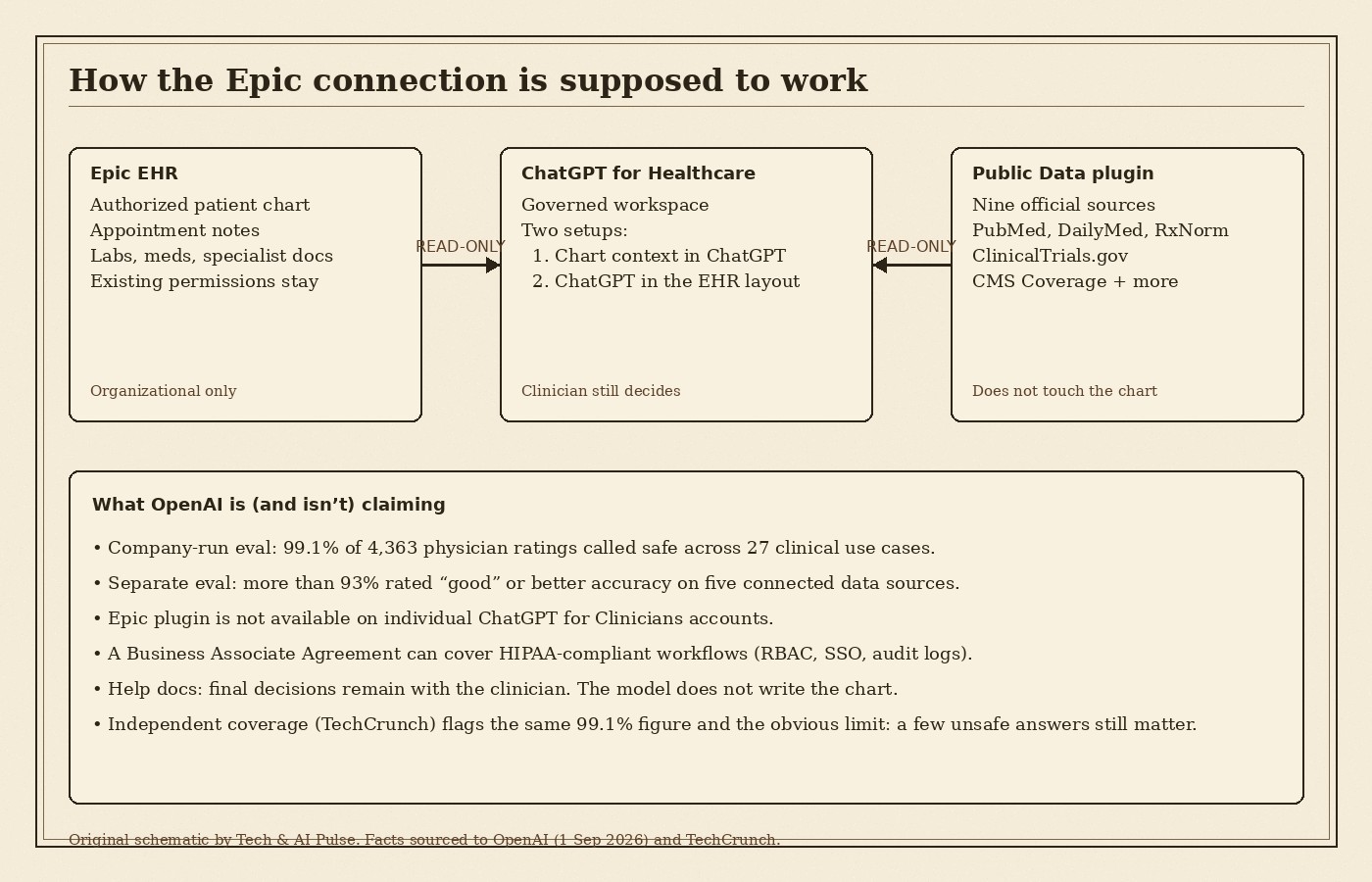
TechCrunch reports the integration is read-only, and that Epic holds data for over 325 million patients. OpenAI’s own help docs say the same thing about the Epic plugin: access is read-only, it follows existing workspace, Epic, and patient-chart permissions, and it is not available on individual ChatGPT for Clinicians accounts. UCSF Health is named as a pilot partner on OpenAI’s announcement.
The public-data plugin is a different pipe
The Healthcare Public Data plugin is a separate piece. OpenAI says it connects nine official public sources, including ClinicalTrials.gov, CMS Coverage, RxNorm, DailyMed, and PubMed. The help center is explicit that those apps are read-only and do not access patient charts.
That split matters. Chart context is organizational and permissioned. Public data is for things like trial eligibility, medication identifiers, and coverage policy versions.
The safety numbers are OpenAI’s
OpenAI says physicians rated 99.1% of responses safe across 4,363 ratings covering 27 clinical use cases, including pre-visit review, clinical timelines, medication review, and handoff summaries. In a separate two-round evaluation, more than 93% of responses were rated “good” or better accuracy for each of five connected data sources.
Those are company-run numbers. TechCrunch’s independent write-up quotes the same 99.1% figure and notes the obvious limit: a few unsafe answers can still hurt someone.
OpenAI also says ChatGPT for Healthcare can sit under a Business Associate Agreement for HIPAA-compliant workflows, with role-based access, SSO, and audit logs. The help center is clear that final decisions remain with the clinician.
What I would not do with it yet
From Mexico, I’m watching this because Epic is the chart a lot of hospitals actually live in. Connecting it is the real story, not another chatbot demo.
I still would not let it write orders, or treat a 99.1% safety score as a green light. Read-only is the right first step. The moment it starts writing back, this becomes a different product.
Hero image: “A corridor on level 0 in the North Devon District Hospital” by Roger A Smith, via Wikimedia Commons / Geograph, licensed under CC BY-SA 2.0. Cropped and color-graded by Tech & AI Pulse.