
I don’t need another “AI will change everything” speech. I need the boring line that actually moves regulators.
Today the Financial Stability Board published a letter from its chair, Andrew Bailey — also Governor of the Bank of England — to G20 Finance Ministers and Central Bank Governors ahead of their meetings in Asheville, North Carolina on 31 August and 1 September 2026. The PDF is dated 28 August. The punchline is blunt.
“For the financial system, the most immediate concern is the potential impact of frontier AI on cyber risk.” That’s Bailey’s line, not mine — on the FSB letter page and in the PDF.
Not the model. The attack surface.
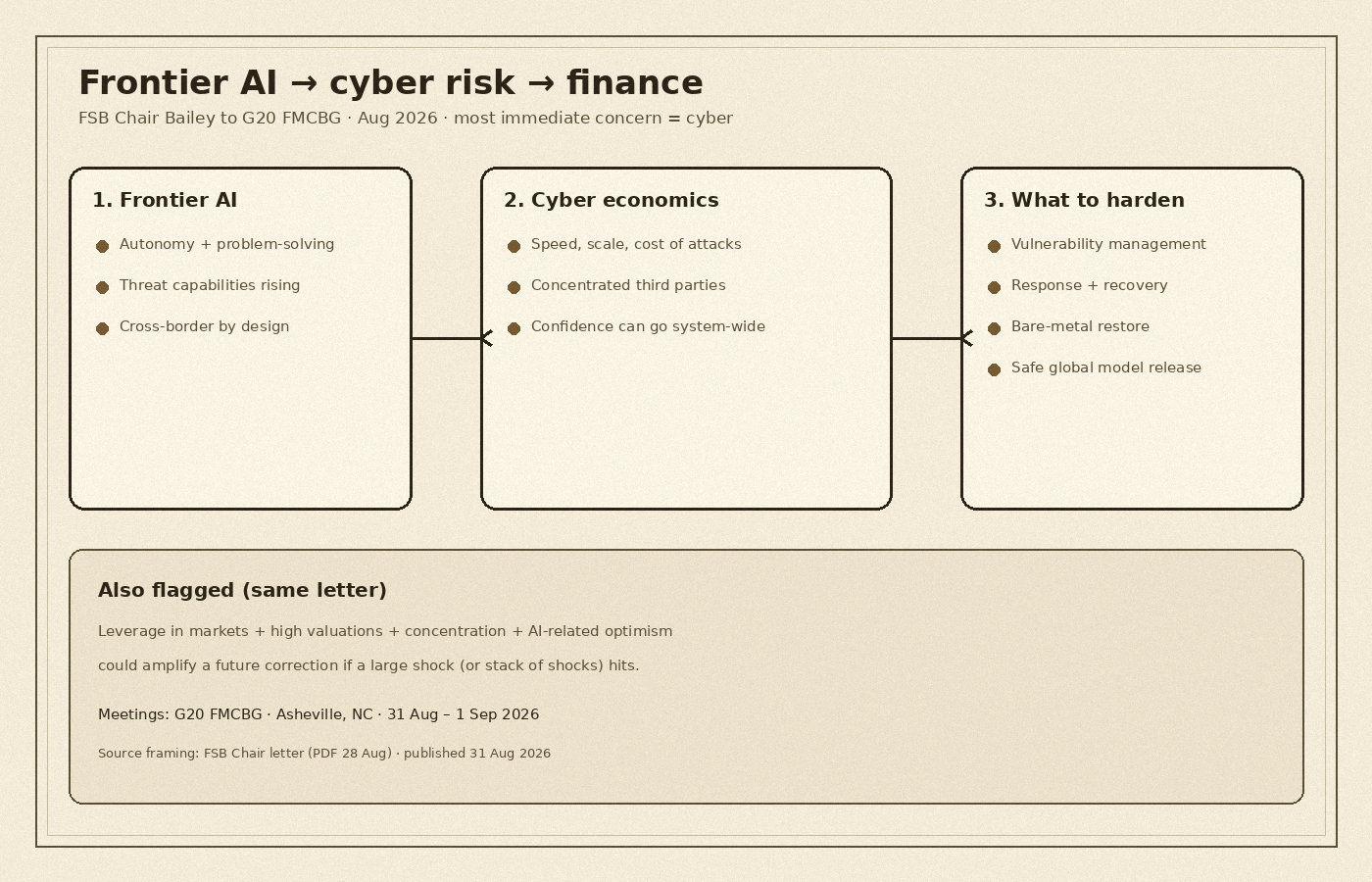
Bailey writes that frontier AI models are showing increasingly sophisticated autonomy and problem-solving abilities, as well as threat capabilities. From Hermosillo that reads as: the tools that help defend networks can also speed up whoever is poking holes.
The letter says frontier AI may materially alter the speed, scale and economics of cyber risk. That can undermine market confidence system-wide — especially because finance leans on highly concentrated third-party service providers. One shared stack goes down, and confidence doesn’t stay local.
The Guardian’s write-up stresses the same point: cyber disruption can spread across jurisdictions through common technology providers and shared infrastructure. Borders don’t help much when the vendor is shared.
What he wants firms and governments to do
On the firm side, the letter is practical. Strengthen vulnerability management, response and recovery. Prepare for simultaneous disruption across multiple firms or shared technology dependencies. Keep the ability to restore critical systems and data from “bare metal” after a significant cyber incident. Resilience among critical third-party tech providers isn’t optional color — it’s the dependency list.
On the authority side, Bailey says many jurisdictions still lack protocols to manage development, release, and deployment of advanced frontier AI models. That heightens risk for finance and beyond. His priority line: take appropriate steps to support safe and responsible model release and deployment on a global basis.
The FSB press note adds that the Board is looking at what it can do within its mandate — including safe deployment of frontier models for cyber defence by financial firms, and better response/recovery from big operational hits.
The other warning: leverage + AI optimism
Cyber isn’t the only flag. Bailey also warns that more leverage in bond and equity markets is interacting with high valuations, market concentration, and AI-related optimism in a way that could amplify a future market correction. He’s worried a large shock — or a stack of shocks — could trigger several vulnerabilities at once. That’s in the FSB press release and the letter.
I’m not here to score Bailey’s politics. I’m noting the framing: for the people who watch systemic risk, frontier AI’s near-term finance problem isn’t a sci-fi takeover. It’s faster cyber against a system that shares too much plumbing — and a market that may be pricing the upside harder than the downtime.