I don’t need another loud tower under the desk. I need a quiet box that keeps working after I close the laptop.
On 25 August 2026 Apple unveiled a new Mac mini with the all-new M6 and M5 Pro, and the pitch is blunt: on-device AI, and an always-on deskside machine for agentic workloads. Pre-order started that day. Ships begin September 22.
From Hermosillo that lands as a desk appliance story, not a “new Mac day” story. Same tiny shell. Different job description.
Prices went up $100
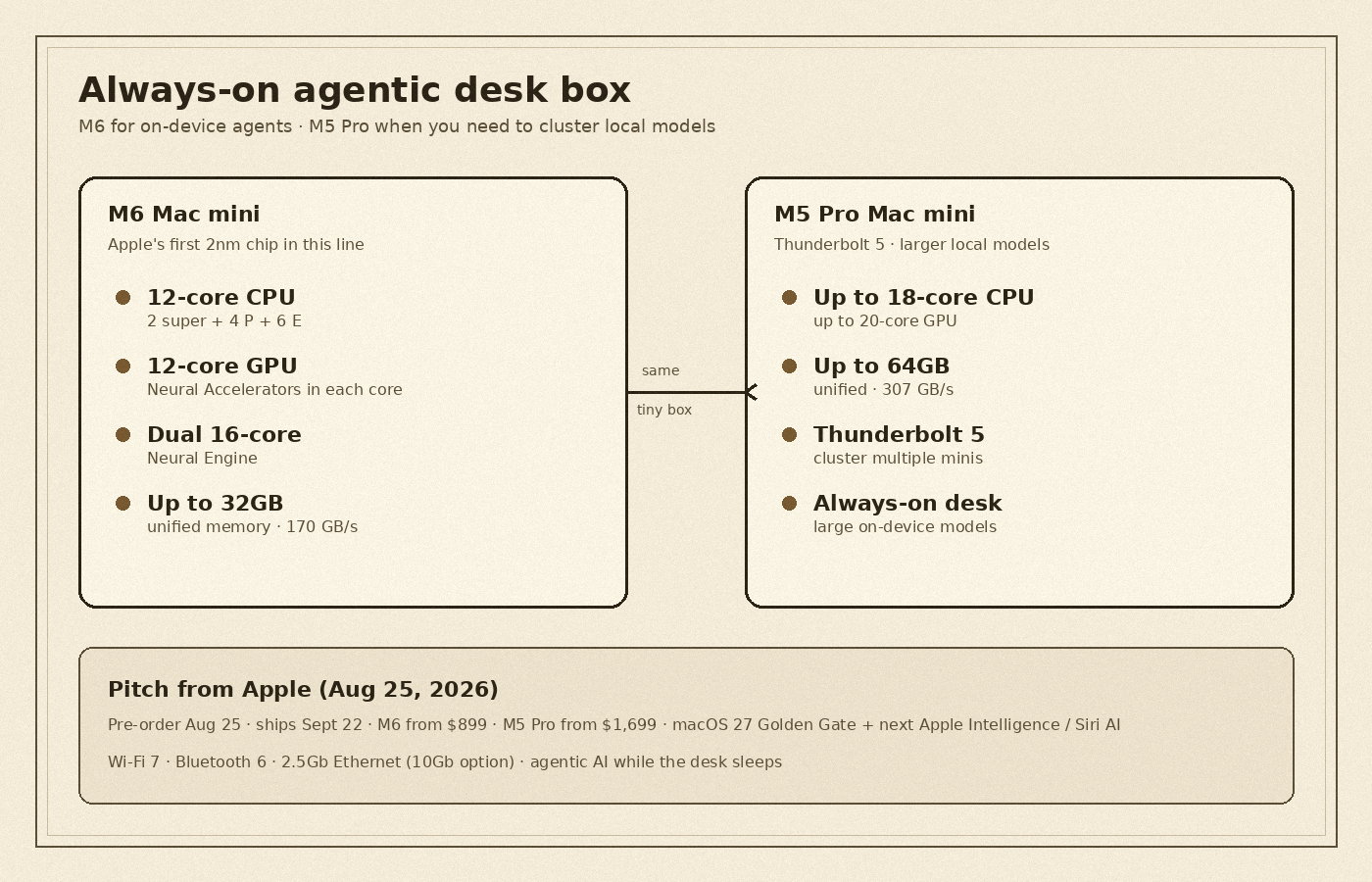
Apple lists Mac mini with M6 from $899 ($799 education) and M5 Pro from $1,699 ($1,599 education). The Verge notes both starts are $100 higher than the M4 generation’s starting prices. M6 configs start at 16GB / 256GB; M5 Pro starts at 24GB / 512GB. Storage is twice as fast as last gen, per The Verge — same note as recent MacBook Air and Pro.
The Verge also says the last-gen minis got scarce because demand for running AI agents ran hotter than Apple expected. That matches the marketing line Apple is pushing now.
M6: first 2nm chip in this line
Apple’s M6 silicon note calls M6 Apple’s first state-of-the-art 2-nanometer chip. The 12-core CPU is 2 super cores, 4 performance cores, and 6 efficiency cores. The 12-core GPU puts a Neural Accelerator in each core — Apple says that’s a first on Mac mini. Dual 16-core Neural Engine. Unified memory up to 32GB, bandwidth up to 170GB/s.
Apple’s Mac mini claims versus the M4 Mac mini: up to 4x faster AI, 2x graphics, and 40% faster CPU. On LLM prompt processing in LM Studio, Apple claims up to 13.5x versus M1 and 4.8x versus M4. Those are Apple’s numbers from its August testing notes — I’m not running the benches myself.
M5 Pro: Thunderbolt 5 clusters
The M5 Pro mini goes up to an 18-core CPU and 20-core GPU, up to 64GB unified memory and 307GB/s bandwidth. Rear ports are Thunderbolt 5. Apple says you can cluster multiple Mac mini systems to run large AI models entirely on device. That’s the “always-on deskside agentic computing” line written into the hardware.
Connectivity on both models: Wi-Fi 7, Bluetooth 6, upgraded 2.5Gb Ethernet with a 10Gb option. Front stays two USB-C (USB 3) plus headphone jack. M6 keeps three Thunderbolt 4 on the back; M5 Pro gets three Thunderbolt 5.
Johny Srouji’s line — and the software bag
Johny Srouji, Apple’s chief hardware officer, said Mac mini has always been the most versatile Mac — home computer, professional studio, or “an always-on agentic device” — and that M6’s CPU, graphics, Neural Accelerators, and memory bandwidth push AI performance further. That’s Apple’s quote, not mine.
New units ship with macOS 27 Golden Gate and the next wave of Apple Intelligence, including Siri AI. Apple’s own footnotes say Siri AI starts as a beta later this year for supported English setups, with more languages later. Features can change by region.
I’m not buying the press-release poetry. I am watching the product shape: a silent cube priced like a serious always-on worker, with Apple finally saying the quiet part out loud — run the agents on the desk, not only in the cloud.