This one is not about a new Claude feature. It is about how the training pile was allegedly built — and who gets to sue over that pile next.
Late Friday, Sony Music Publishing and Warner Chappell Music filed a federal copyright complaint in the U.S. District Court for the Northern District of California. The suit names Anthropic plus co-founders Dario Amodei and Benjamin Mann. According to the filing, the company ran a “brazen campaign of illegally torrenting, scraping, and downloading copyrighted works” to develop Claude. That quote is the publishers’ language in the complaint — not a court finding.
Anthropic’s response to TechCrunch was short and clear: “We disagree with the publishers’ claims and we intend to defend ourselves robustly in court.”
What the filing says
Music Business Worldwide, which obtained the complaint, reports four counts: direct infringement by torrenting against all three defendants; contributory infringement by torrenting against Amodei and Mann; and, against Anthropic alone, direct infringement plus removal or alteration of copyright management information. The publishers want a jury trial, destruction of allegedly infringing copies, and an account of Claude’s training data.
On the acquisition story, the complaint — again, as alleged — says Mann used BitTorrent in June 2021 to download at least five million pirated books from Library Genesis, and that Anthropic employees torrented at least two million more from Pirate Library Mirror in July 2022. Those figures track findings discussed in the earlier authors’ case. The publishers also allege Anthropic scraped lyrics from licensed platforms including MusixMatch and LyricFind, and they name compositions such as “Ain’t No Mountain High Enough,” “Eye of the Tiger,” and Taylor Swift’s “Paper Rings” among works they say were harvested.
They are asking for statutory damages of up to $150,000 per work they claim was willfully infringed, across “tens of thousands” of compositions, plus up to $25,000 for each alleged removal of copyright management information. That is exposure math under the statute — not a verdict and not a check Anthropic has been ordered to write.
Piracy theory, not just fair use
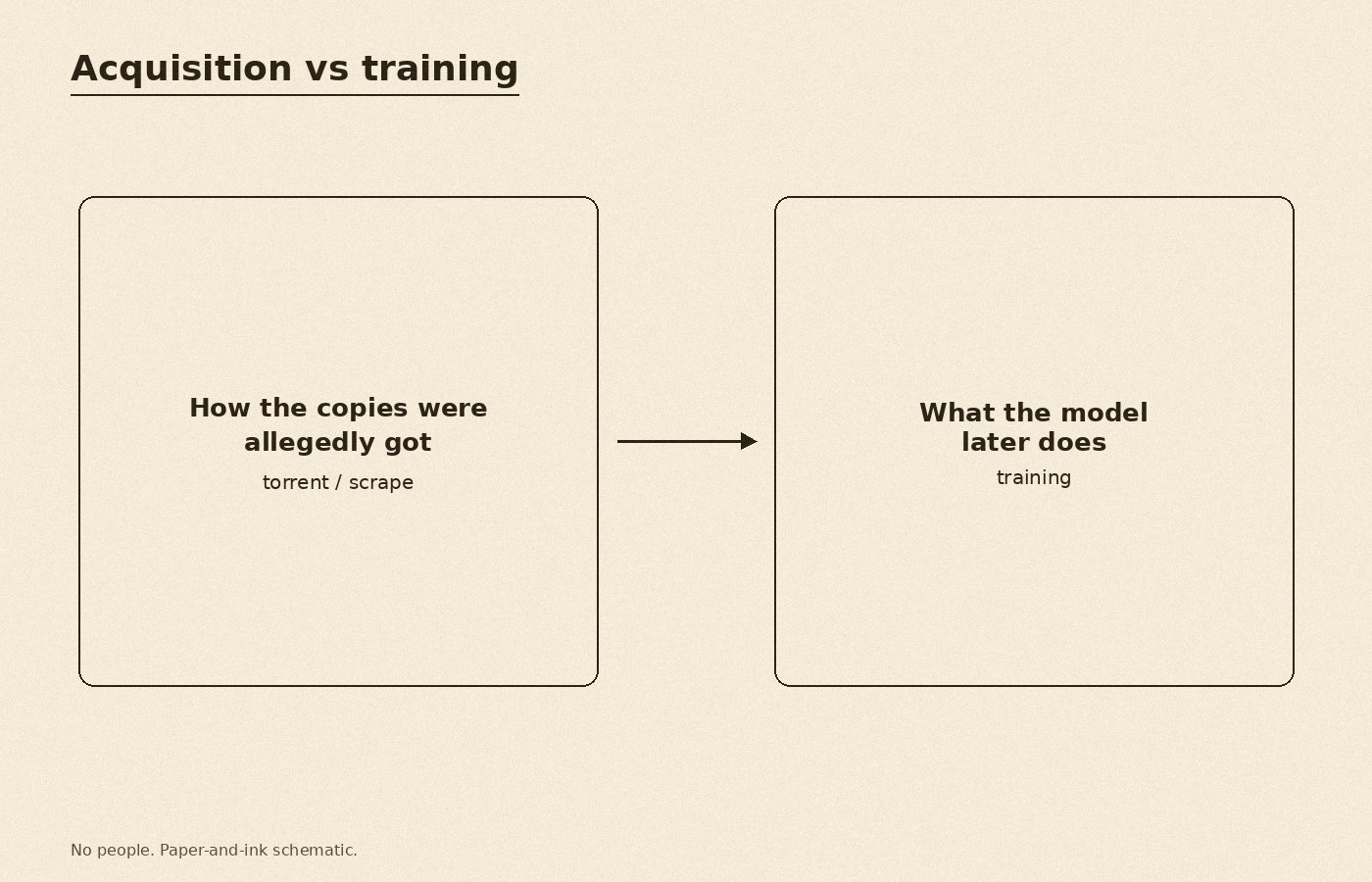
A lot of AI copyright coverage still circles the fair-use question. This complaint, like the authors’ case before it, leans hard on how the data was allegedly obtained. Byteiota’s write-up puts it plainly: the theory is piracy-not-training. If a court buys that framing, “training is transformative” does less work as a shield.
TechCrunch notes this is not Anthropic’s first IP fight. Some of the same lawyers behind this suit also represent Concord Music Group and Universal Music Group in a January case, and they led Bartz v. Anthropic, where authors accused the lab of using copyrighted works to train products like Claude. Anthropic agreed to a $1.5 billion settlement in that authors’ matter over the torrenting conduct; TechCrunch also reports the company was ordered to pay that figure after a judge drew a line between using copyrighted works and acquiring them through piracy. I am treating that as settled history reported by the outlets I opened — not as proof of anything in this new music case.
Why it lands now
With Sony and Warner in, MBW points out the publishing arms of all three majors are now litigating against Anthropic. Universal, Concord, and ABKCO already have their own actions; BMG and Round Hill filed earlier cases too. Same district for several of these fights. Same legal theory showing up again and again.
None of that means Anthropic loses this one. A complaint is a complaint. The company says it will defend. What I am watching is the stack: authors settled, other music suits are pending, and now Sony and Warner Chappell have opened another front over lyrics and compositions. If you care about who pays for training data — and who gets sued when the answer is “we grabbed it first” — Friday’s filing is the story.