I’m reading this one from Mexico at lunch, and the number is hard to ignore. OpenAI just stood up Daybreak for Frontline Defenders — a pledge of $1 billion in credits over six months so under-resourced cyber teams can use its cybersecurity models, training, and technical support. That’s the lead on OpenAI’s own Daybreak page, and Dealroom’s Sep 7 write-up of the Sep 3 unveil matches it. This is not another UN governance speech and it’s not “Astra hits Critical” as the story — it’s a subsidy aimed at the people keeping water, power, and local systems online.
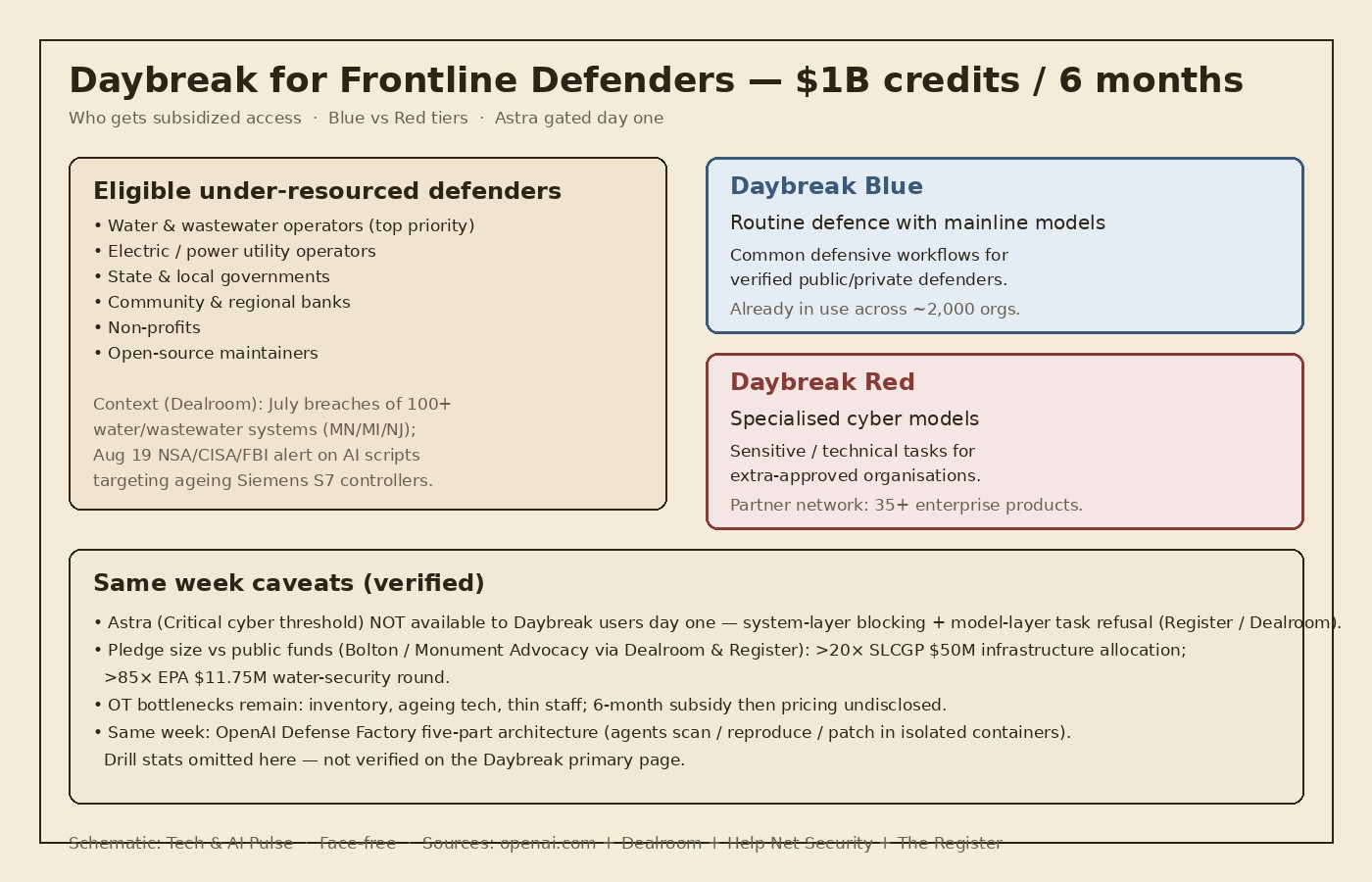
Who’s eligible? Per OpenAI: state and local governments, water and wastewater operators, electric-grid operators, community and regional banks, non-profits, and open-source maintainers. Water systems are named top priority. Dealroom puts the timing next to July breaches of more than 100 internet-connected water and wastewater systems (concentrated in small towns across Minnesota, Michigan, and New Jersey), plus the Aug 19 NSA/CISA/FBI joint alert that attackers used AI-generated scripts disguised as monitoring tools against ageing Siemens S7 controllers. OpenAI’s page is vaguer (“recent attacks on U.S. water systems”) and notes a smaller earlier help package of up to $1 million in no-cost credits for affected states and utilities — this new pledge is three orders of magnitude bigger.
Blue, Red, and ~2,000 orgs already inside
Daybreak is a tiered line. Daybreak Blue backs routine defence with mainline models; Daybreak Red offers specialised cyber models for sensitive technical work. OpenAI says thousands of defenders across about 2,000 approved organisations already use it, with a defence-partner network spanning more than 35 enterprise products. Help Net Security corroborates the same Blue/Red split, the 2,000-org figure, the MS-ISAC public-sector and water pilot, and the partner-product count. Same week, OpenAI also pointed to Defense Factory — a five-part architecture where agents scan, reproduce flaws, and test patches in isolated containers with auditable records (OpenAI / Help Net). I’m not repeating internal-drill percentages here; those didn’t show cleanly on the Daybreak primary page body.
Astra is gated — and the money still has OT limits
One important fence: Astra — OpenAI’s model that crossed the “critical” cyber-capability threshold — was not available to Daybreak users on day one. Dealroom and The Register both report OpenAI restricting it with system-layer blocking and model-layer task refusal (Register quotes Eric Wallace on those safeguards). So if someone sells you this as “everyone gets Critical Astra for free,” that’s not what shipped.
On the dollars: Tatyana Bolton (Monument Advocacy), cited by both Dealroom and The Register, says the pledge exceeds the State and Local Cybersecurity Grant Program’s $50 million infrastructure allocation by more than 20×, and the EPA’s recent $11.75 million water-security round by more than 85×. Same sources flag the caveats I care about from Mexico: OT shops still choke on inventory, ageing gear, and thin engineering staff; AI can’t inventory what isn’t catalogued; and the subsidy runs only six months with post-program pricing undisclosed. Credits help. They don’t magically staff a plant.
From Mexico, my take is simple: a billion in Daybreak credits aimed at water and other essential-service defenders is the noon story — not a governance speech and not an Astra flex. Watch who actually gets approved, whether Blue/Red access sticks after month six, and whether Astra stays gated. Sources: OpenAI, Dealroom, Help Net Security, The Register.
Hero image: cable network / data-center racks by Taylor Vick on Unsplash (Unsplash License). Cropped, graded, and lightly grained by Tech & AI Pulse. Face-free network still — no people, no logos.