I’m reading this one from Mexico mid-afternoon, and the useful part isn’t another AI PC brochure — it’s software. At IFA, NVIDIA shipped Personal AI Router (PAIR): free, open-source tooling that finds compatible machines on your home network and sends independent local inference jobs to whichever node actually has room. That’s the lead on the NVIDIA Blog IFA post, and GCN’s Sep 7 write-up matches it. This isn’t today’s UN red-lines thread and it isn’t another billion-dollar credit pledge — it’s how you stretch the PCs you already own for local agents.
First clarification, because the name is doing too much work: PAIR is not a hardware router. The Verge spells that out. It’s a virtual inference router that sits in front of the engines you already run. Per the NVIDIA Tech Blog, PAIR is not a new inference engine. Ollama or LM Studio still runs the model on the chosen box. Your agent keeps talking to a familiar local endpoint; PAIR proxies that interface, so you don’t rewrite the harness.
How the home cluster actually works
Discovery is mDNS on the LAN (or add a node by IP). You approve pairing with a six-digit code, then traffic rides mTLS with generated certificates — again The Verge and the Tech Blog. The scheduler looks at readiness, whether the right engine is up, whether the exact model tag is present, current jobs, and GPU utilization (including “is someone gaming on this card?”). Nodes can join when idle and drop when they sleep or get reclaimed. The beta covers Windows, macOS, and Linux; hardware support includes GeForce RTX 20 Series and newer, RTX PRO (Turing+), DGX Spark, and Apple M4 or newer (NVIDIA Blog / Tech Blog).
NVIDIA’s pitch for why this matters: more than half of U.S. households already have two or more PCs, and a lot of that silicon sits idle (NVIDIA Blog). Product manager Seth Schneider, talking to The Verge, said the realistic target is closer to one laptop plus one gaming PC — not a fantasy lab. There’s an extreme household anecdote at ~165 teraflops of underused compute; I’m not selling that as typical.
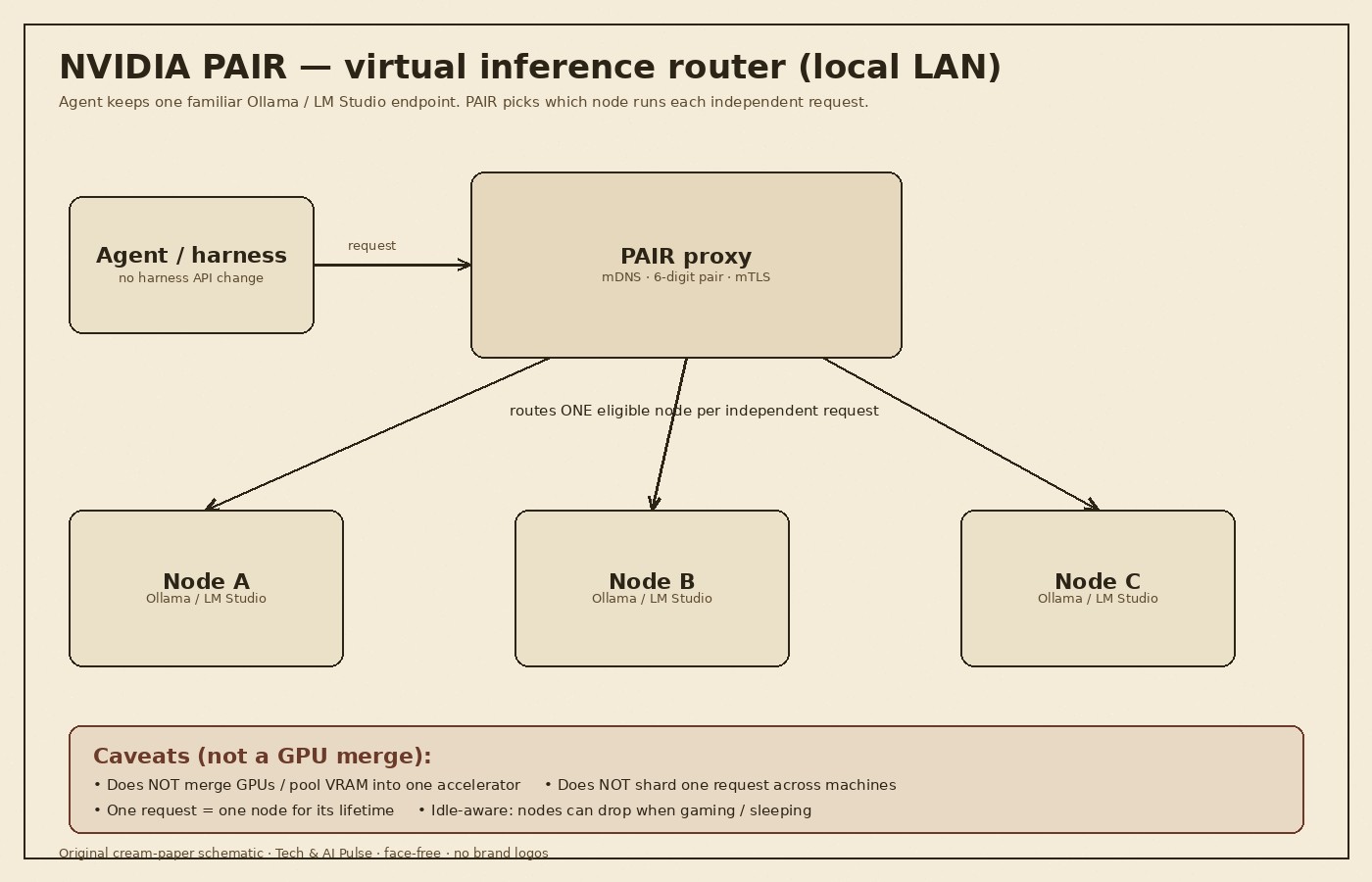
What PAIR does — and what it refuses to pretend
The important limits are written plainly on the Tech Blog: PAIR does not merge GPUs or pool VRAM into one bigger accelerator, and it does not shard a single model call across machines. One request lands on one eligible node for its whole lifetime. It’s workload-level concurrency for multi-agent / multi-subagent jobs — parallel independent calls, not tensor-parallel magic over Wi-Fi.
Their unofficial demo still helps set expectations. Hermes splits a synthetic “Sunday Reset” inbox into five subagents on Qwen3.6-35B via Ollama: about 18 minutes on a single RTX Spark laptop versus 8 minutes 48 seconds on a three-device PAIR cluster (RTX Spark + DGX Spark + RTX 5090). Same numbers show up on the Tech Blog and in GCN. NVIDIA flags it as configuration-specific, not a universal benchmark — which is the honest framing.
Secondary IFA context, not the lead: llama.cpp is up to 1.9× higher throughput on an RTX 5090; Hermes, OpenClaw, and Perplexity Portable Computer are getting simpler one-click local setup on NVIDIA GPUs; and RTX Spark Windows PCs land in October with Grace + Blackwell, up to about 1 petaflop and 128GB unified memory (NVIDIA Blog / GCN). From Mexico, my take is simple: if you already run local agents on more than one box, PAIR is the afternoon story — download is pointed at NVIDIA’s AI-on-RTX page per GCN. Watch whether idle-aware routing holds up when the gaming PC wakes up mid-job. Sources: NVIDIA Blog, NVIDIA Tech Blog, The Verge, GCN.
Hero image: server racks with illuminated network cables by Taylor Vick on Unsplash (Unsplash License). Cropped, graded, and lightly grained by Tech & AI Pulse. Face-free network still — no people, no logos.