Lyte’s own press release says the physical AI perception company closed a $165 million Series C led by Maverick Silicon, valuing Lyte at $1.6 billion post-money. The announcement landed September 2, 2026. SiliconANGLE covered the round the same day. I’m reading it as a bet that robots still fail at seeing the world before they fail at modeling it.
Andrew Homan, managing partner at Maverick Silicon, joins the board. The syndicate includes Fidelity Management & Research (which led the Series B), Atreides Management, Key1 Capital, Ora Global (formerly Exor Ventures), and other existing and new investors, per the company PR. Total capital raised since the 2021 founding now sits at $272 million. Lyte emerged from stealth in January 2026 with $107 million already raised — Ctech’s write-up tracks how fast that valuation moved.
HQ is Sunnyvale in the official release. Founders are Alexander Shpunt (CEO), Arman Hajati, and Yuval Gerson — former Apple engineers. Shpunt co-founded PrimeSense, the depth-sensing company behind Kinect that Apple bought in 2013; that lineage fed Face ID. Tech Funding News frames it that way, and I’m fine with that history when it’s sourced.
LyteVision: measure first, reconstruct less
The product is LyteVision. Per Lyte, it fuses 4D coherent vision, high-resolution imaging, and inertial sensing onto one synchronized timeline. Custom silicon measures position and motion natively instead of reconstructing them in software. Since stealth, the company says it entered production and is shipping to inspection, logistics, and manufacturing robotics customers. LyteVision was named CES 2026 Best of Innovation in Robotics. Capital goes to scale sensing silicon and LyteVision production, advance AI/perception, expand deployments, and grow the team across silicon, software, optics, manufacturing, ops, and GTM.
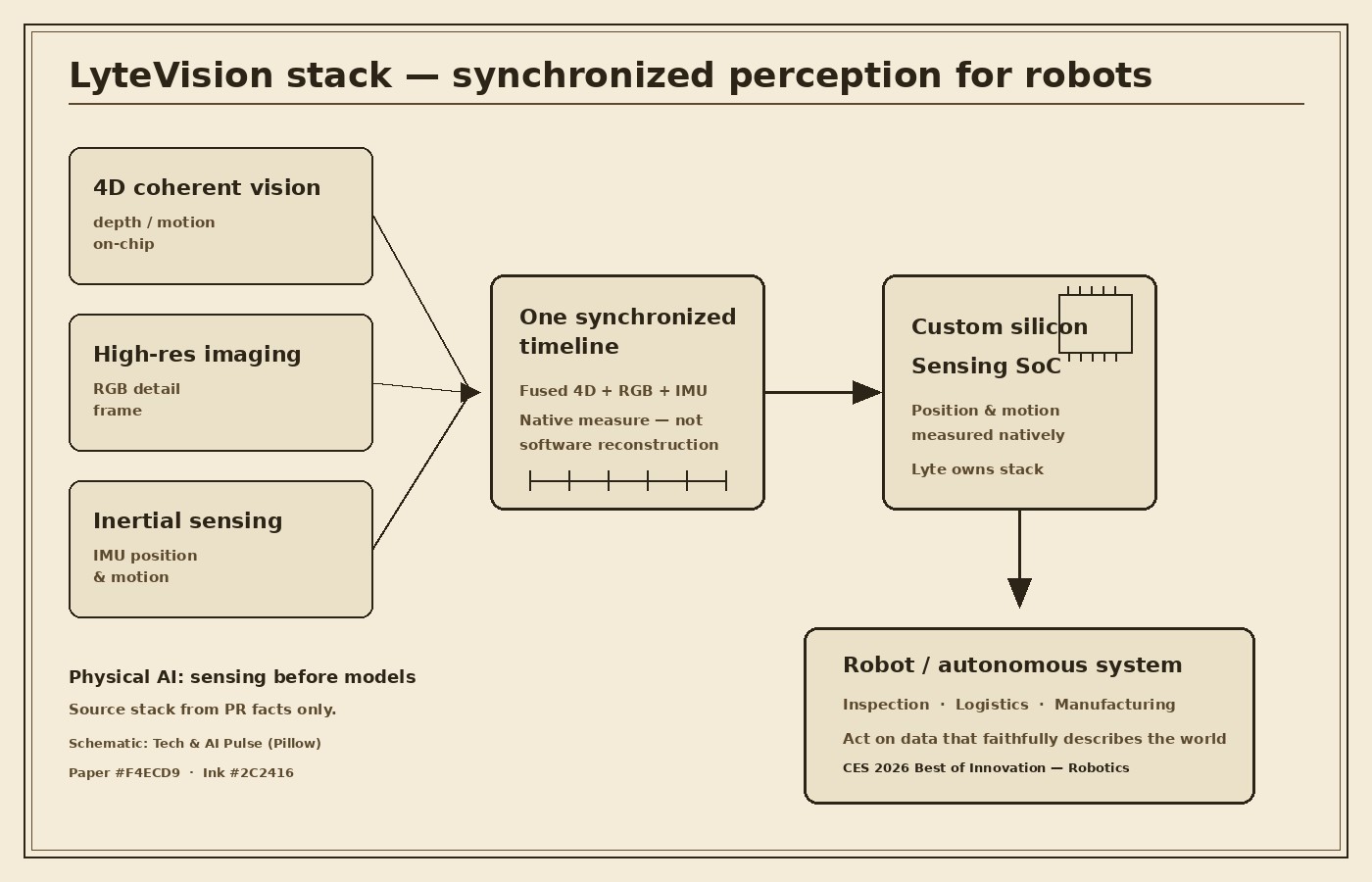
Shpunt’s line in the PR is the one I’m keeping: “Physical AI has a sensing problem before it has a model problem. A robot cannot act safely on data that does not faithfully describe the world…” That’s not marketing fluff if you’ve watched factory arms hesitate on bad depth. SiliconANGLE puts the same perception thesis up front.
Crowded field, one clear claim
Tech Funding News puts Lyte next to other perception names for context — Rhoda AI’s $450M at $1.7B in March, RealSense’s $50M Intel spinout, Luxonis’s $14M Series A in July. Those are TFN’s comparisons, not my scorecard. Lyte’s claim is narrower: own the sensing stack from transistor to spatial data, ship production units, and use this Series C to put LyteVision on more robots faster. Ctech and the official release agree on the round size and the $1.6B mark.
From Mexico, I’m watching the eyes, not the pitch deck
From Mexico, I care less about another unicorn headline than about whether a robot arm in Hermosillo — or anywhere — can trust what it sees. Cheap models are everywhere. Trustworthy depth and motion still aren’t. Lyte’s $165M bet is that custom silicon beats bolted-together cameras. I’ll believe the category when more factories stop blaming “the vision stack” for every near-miss. Until then, I’m glad someone with Face ID scars is raising for the sensing layer first.
Hero image: circuit board by Alexandre Debiève on Unsplash (Unsplash License). Cropped, graded, and lightly grained by Tech & AI Pulse.