
From Mexico — the practical bottleneck in agentic coding isn’t starting an agent. It’s verifying, owning, and governing what that agent ships across the IDE, the team, and org policy. On Sep 22, Kirill Skrygan’s JetBrains Blog post announces JetBrains Air: an open multi-surface system that packages earlier Central / CLI / cloud-agent / governance work for developers, teams, and organizations — inside and beyond JetBrains IDEs. This is JetBrains’ own platform story (IDE agents + delivery + governance + multi-vendor agents), not another frontier model landing in a third-party picker.
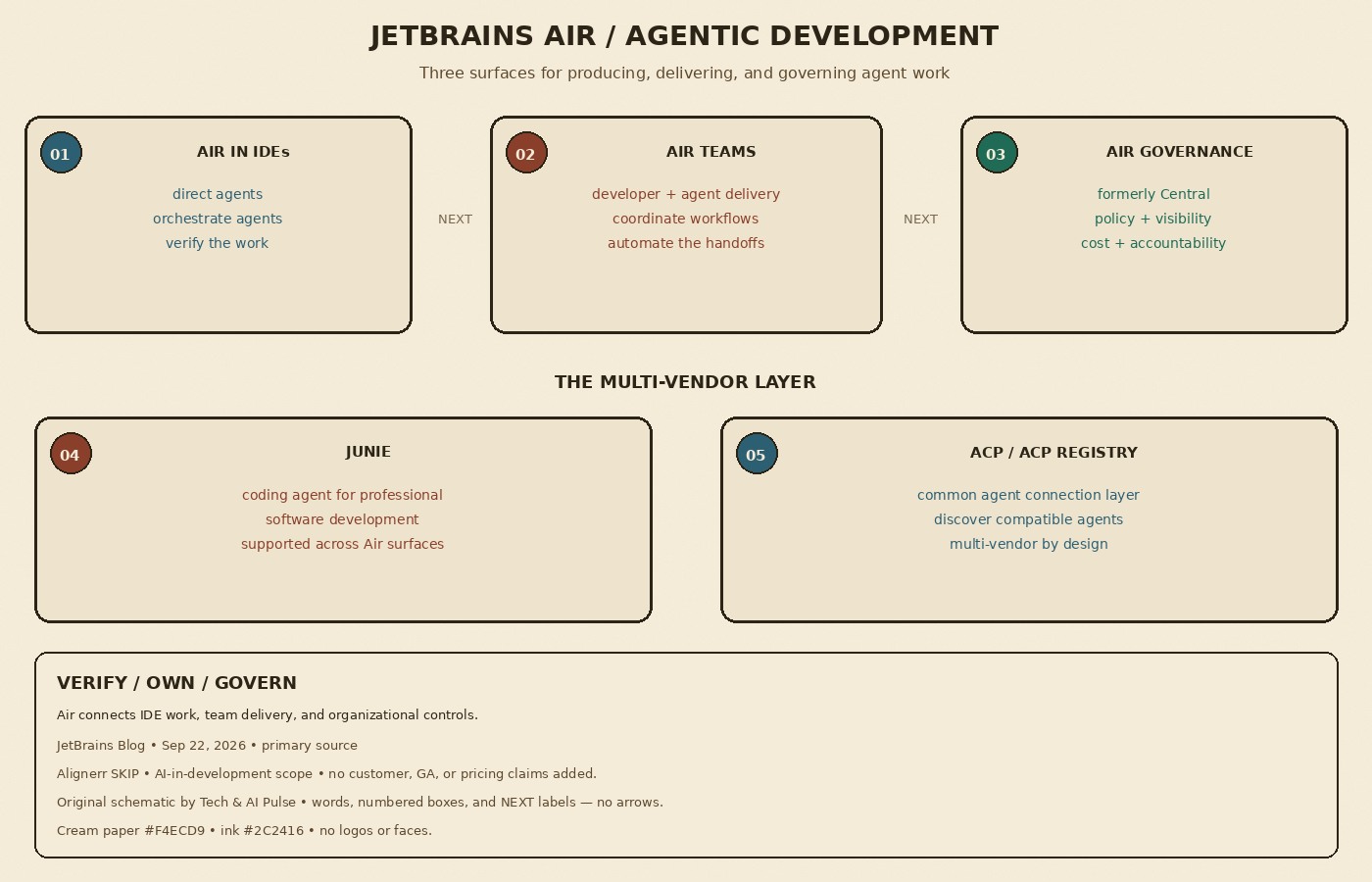
Three Air surfaces
Per the official post, Air includes products available today alongside others that roll out as the system develops:
- Air in JetBrains IDEs — direct and orchestrate agents, and verify their work, inside JetBrains IDEs.
- Air Teams — coordinate and automate software-delivery workflows that involve developers and autonomous agents.
- Air Governance (formerly JetBrains Central) — organizational policy, visibility, auditability, cost management, and accountability for AI-assisted and agent-driven development.
Junie stays JetBrains’ coding agent for professional software development and is supported across Air surfaces. The IDE pitch is familiar to anyone living in IntelliJ-class tools: agents produce change; you still need code intelligence to understand and verify it.
ACP and the Registry: multi-vendor by design
JetBrains frames the future as multi-vendor: no single model or agent wins every task. The Agent Client Protocol (ACP) standardizes how an IDE talks to an agent’s full harness (planning, tools, model routing, observability). Through the ACP Registry, developers can discover and run compatible agents while staying in JetBrains IDEs. Air Governance is positioned to extend visibility and cost controls across providers — so choosing a better agent for a job doesn’t mean giving up org context or spend visibility. The Sep 22 post doesn’t publish customer counts or “replaces X” claims; the architecture above is what they shipped.
Rolling releases — available vs preview
Air ships as a rolling series of releases. JetBrains says it will be explicit about what you can use now, what’s entering preview, and what’s longer-term — including future mobile/remote initiation and more event-triggered agent work. They will not name future products before scope and availability are ready. There’s no global GA date or price sheet in the post, so I’m not inventing one.
My takeaway
Agents made producing change cheaper. The expensive part moved to review, rework, security, spend, and who owns the 3 a.m. break. Air is JetBrains betting that IDE agents, team workflows, and org governance have to sit in one multi-surface system — and that multi-vendor ACP is the floor, not a nice-to-have. Whether your shop needs all three surfaces is a local call; the Sep 22 post is the primary map.