Google DeepMind and Google Research just pushed a weather model into the products people actually open. On Sep 3 they introduced WeatherNext 3 and started wiring it into Search, Maps, the Maps Platform Weather API, Earth Engine, and Cloud data paths. I’m reading this as “forecast cadence + resolution,” not another research-only chart.
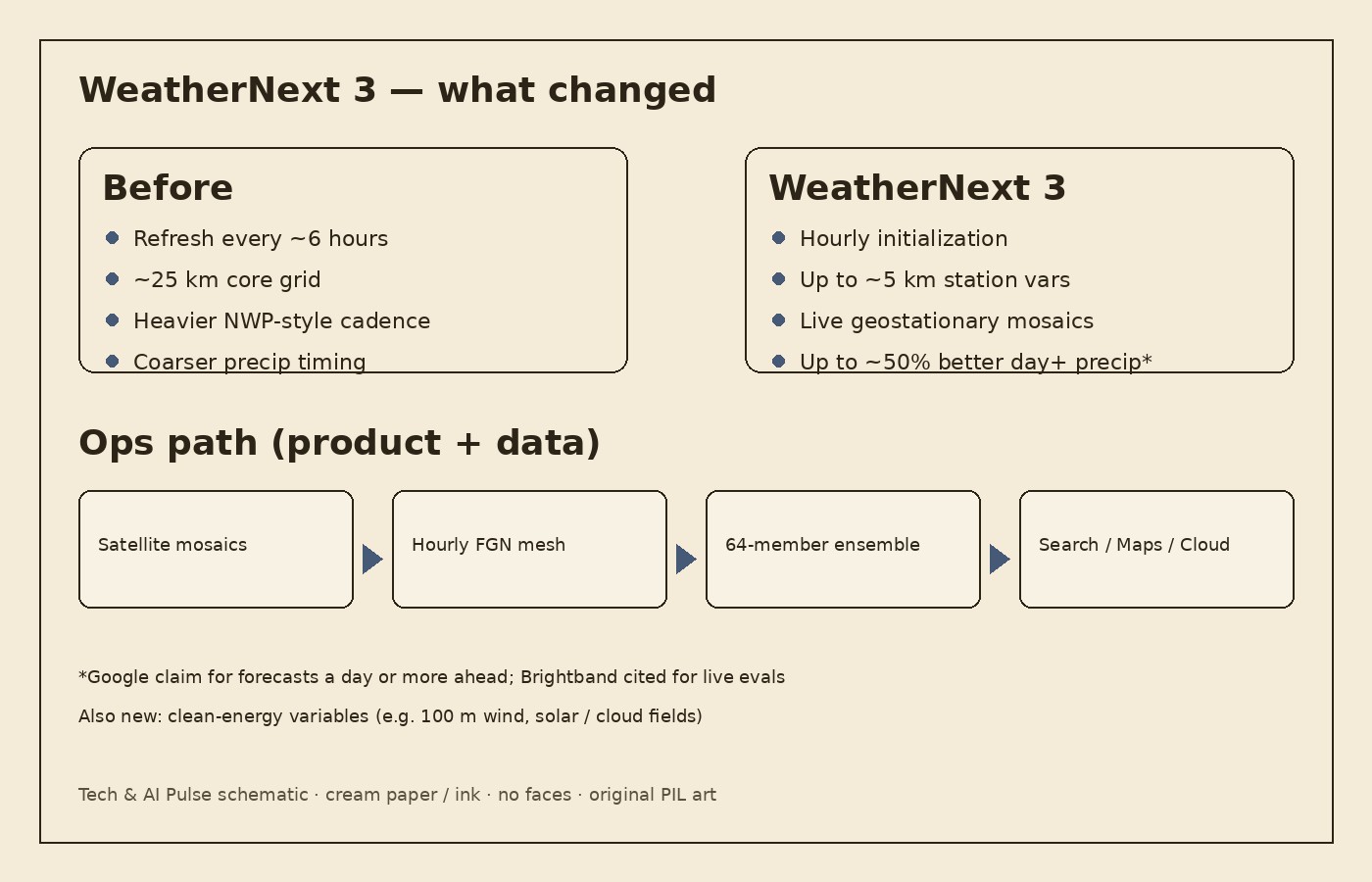
From Mexico, I’m watching AI weather that refreshes before the storm finishes moving. Per the official WeatherNext 3 post, the stack now ingests live geostationary satellite mosaics and trains on station observations — then ships hourly forecasts instead of the old ~6-hour rhythm. PPC Land and the Google Developers model guide spell out the same jump: hourly initialization, multi-resolution output, and a Functional Generative Network (FGN) mesh transformer with a 64-member ensemble.
Hourly beats stale grids
Google says WeatherNext 2 sat on a ~25 km grid with 6-hour increments. WeatherNext 3 targets key surface variables (temperature / moisture) at about 5 km, other surface fields near 10 km, and atmospheric wind fields near 25 km — roughly a five-times-sharper global picture in Google’s framing. The developers guide lists the same multi-res ladder (0.05° / 0.1° / 0.25°) and notes 15-day horizons on major synoptic cycles, with shorter interim hourly runs.
That’s the part that matters operationally. A six-hour refresh can be almost a full work block behind before the next update. Hourly inits compress the stale window. Google also points to Latin America, Africa, and Asia-Pacific as regions that historically paid a supercomputer tax for high-res regional models — a single global satellite-trained stack changes the cost story, even if local meteorological agencies still own official warnings.
Precip claims, clean-energy dials
Rain is where global models usually blur. Google says it trained precipitation against NASA IMERG plus its own satellite-radar reanalysis, and reports medium-range CRPS gains of up to ~60% vs IMERG, ~30% vs MRMS, and ~10% vs rain gauges at early lead times — company metrics, not an external audit. For consumers planning a day or more ahead, Google claims up to ~50% more accurate precip in product surfaces, with the biggest lifts where forecasts were historically weaker. PPC Land correctly flags those as ceilings without a full lead-time table in the announcement.
The energy angle is quieter but dense. WeatherNext 3 adds 100-metre wind (roughly turbine hub height) plus high-res cloud cover and solar radiation fields so grid and renewables teams can estimate generation — spelled out in both the launch post and the developers guide. Data access is BigQuery, Earth Engine, and Cloud Storage bulk downloads, with Google citing Brightband live evaluations for the “most accurate” framing.
From Mexico, I’m watching the refresh
From Mexico, I’m not replacing SMN alerts with a blog post. Google’s own disclaimer still points severe weather to national meteorological services. I am logging a product move: hourly AI weather with sharper local grids, live satellite inputs, and clean-energy variables now sitting behind everyday Search/Maps surfaces and Cloud pipelines. Next proof is whether the precip ceilings hold outside Google’s slides. Sources: Google WeatherNext 3, PPC Land, Google Developers. Note: the model guide lists an August 2026 release line; the Sep 3 post is the consumer/product integration day I’m covering here.
Hero image: storm clouds by Johannes Plenio on Unsplash (Unsplash License). Cropped, graded, and lightly grained by Tech & AI Pulse.