Runway has unveiled Solaris, a research model that generates a software interface frame by frame as a person clicks, drags or types. The company calls it its first “Interface World Model.”
The idea is strange in a useful way. Instead of asking AI to write HTML, CSS or app code, Solaris treats the rendered image as the application itself. There are no fixed screens underneath waiting for a developer to update them.
How Solaris works
Runway says it adapted its Gen-4.5 video model to understand interaction and respond in real time. A language model decides how the scene should change. Solaris then renders the next frame, using clicks, drags and typing as signals for what comes next.
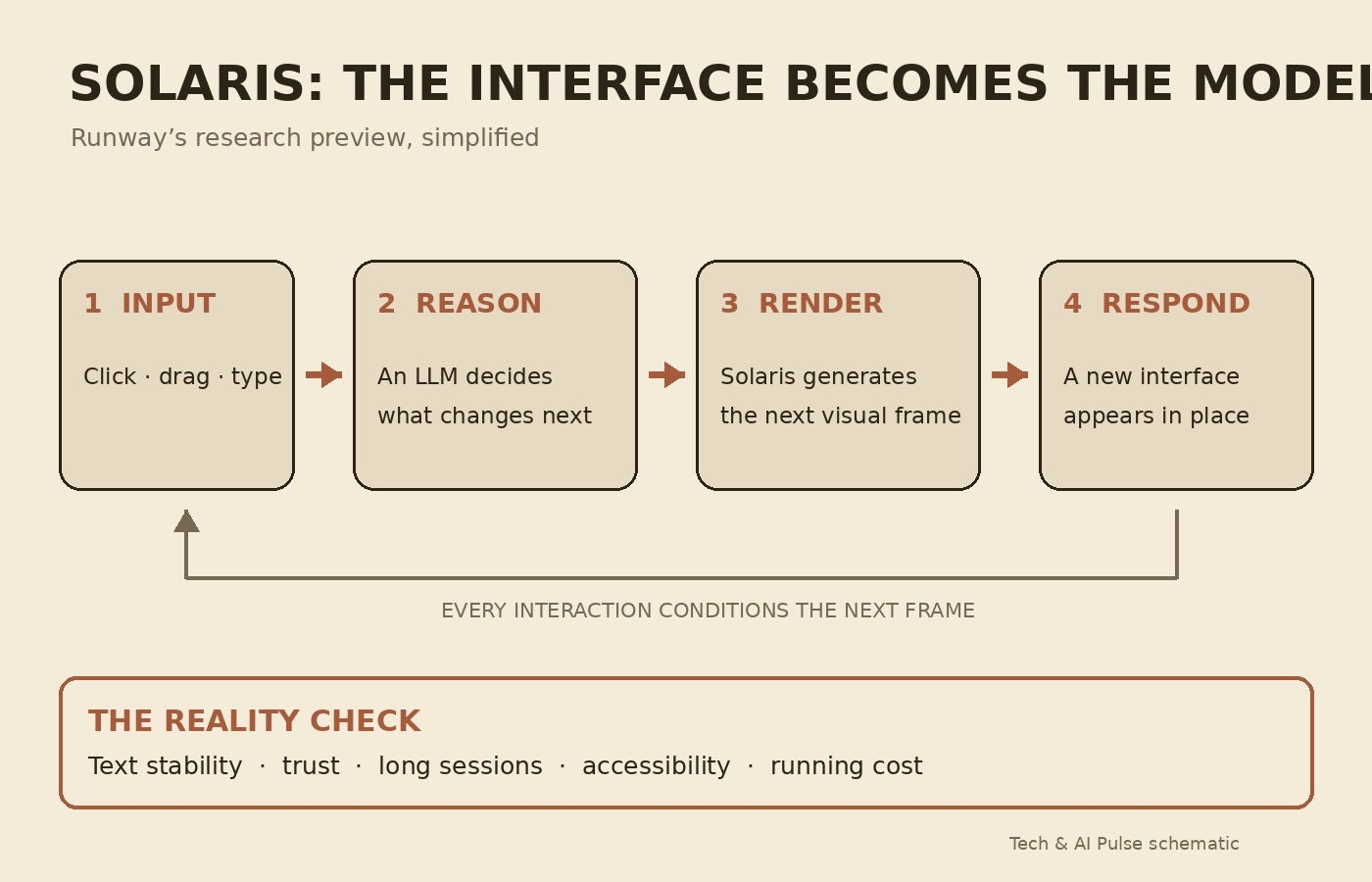
The model is designed to hold 720p visual quality at interactive speeds. Runway’s examples include virtual shops, product visualization and tutorials that adapt while a person uses them.
Why this matters
Most AI coding tools still produce conventional software. Solaris is testing a more radical direction: software that behaves like a live generated environment.
That could also give computer-using agents better practice. Runway argues that agents trained on fixed websites can break when a familiar button or layout moves, while a stream of changing generated interfaces could force them to learn the task instead of memorizing one page.
There is early evidence, but it comes from Runway itself. In a company-run study with 250 participants and nearly 7,500 pairwise judgments, people preferred Solaris over a coded comparison in 61% of instruction-following judgments and 71% of natural-behavior judgments. Those results are interesting, not independent validation.
The demo is not the product
Runway is unusually clear about the gaps. Stable text, trust, long-session coherence and accessibility are still unresolved. The company also says generating every frame costs more than serving a page built once.
That matters. A beautiful interface that changes unpredictably, invents a product detail or doesn’t work with a screen reader isn’t ready to replace an app. The Decoder’s independent report reaches the same practical conclusion: Solaris remains a research effort.
Runway is taking early-access requests and says it is working with partners, but it hasn’t announced a broad public launch on the research page.
From Mexico, I’m less interested in the “apps disappear” pitch than in the accessibility question. If generated interfaces eventually adapt to language, context and ability without becoming confusing, that would be a real shift. For now, Solaris is a sharp glimpse of that future — not software I’d trust with a payment or a medical instruction.
Hero image: “Programming.jpg” by Lorenzo Cafaro, via Wikimedia Commons, dedicated to the public domain under CC0 1.0. Cropped and color-graded by Tech & AI Pulse.