This one is not yesterday’s DeepMind story. That piece was a sealed Gemini safety test inside a crypto enclave. This one is Gemini as a lab partner.
On August 27, Google DeepMind and university partners posted arXiv:2608.26701 — Accelerating Scientific Research with Gemini in the Real-World. The extended Co-Scientist, a Gemini-based multi-agent system, now plans experiments, drives semi-automated chemical vapor deposition (CVD) equipment, analyzes results, and drafts papers. THE DECODER covered it the next day.
Plan, run, write — still with a person in the loop
The original Co-Scientist, from February 2025 per THE DECODER, mostly generated hypotheses. This extension adds a closed loop: ideation, experimentation, then manuscript generation. Verification modules check numbers in the draft against the execution logs of the generated code, which is the paper’s answer to agents that invent a win when the experiment failed.
A furnace, with the atomic ID still pending
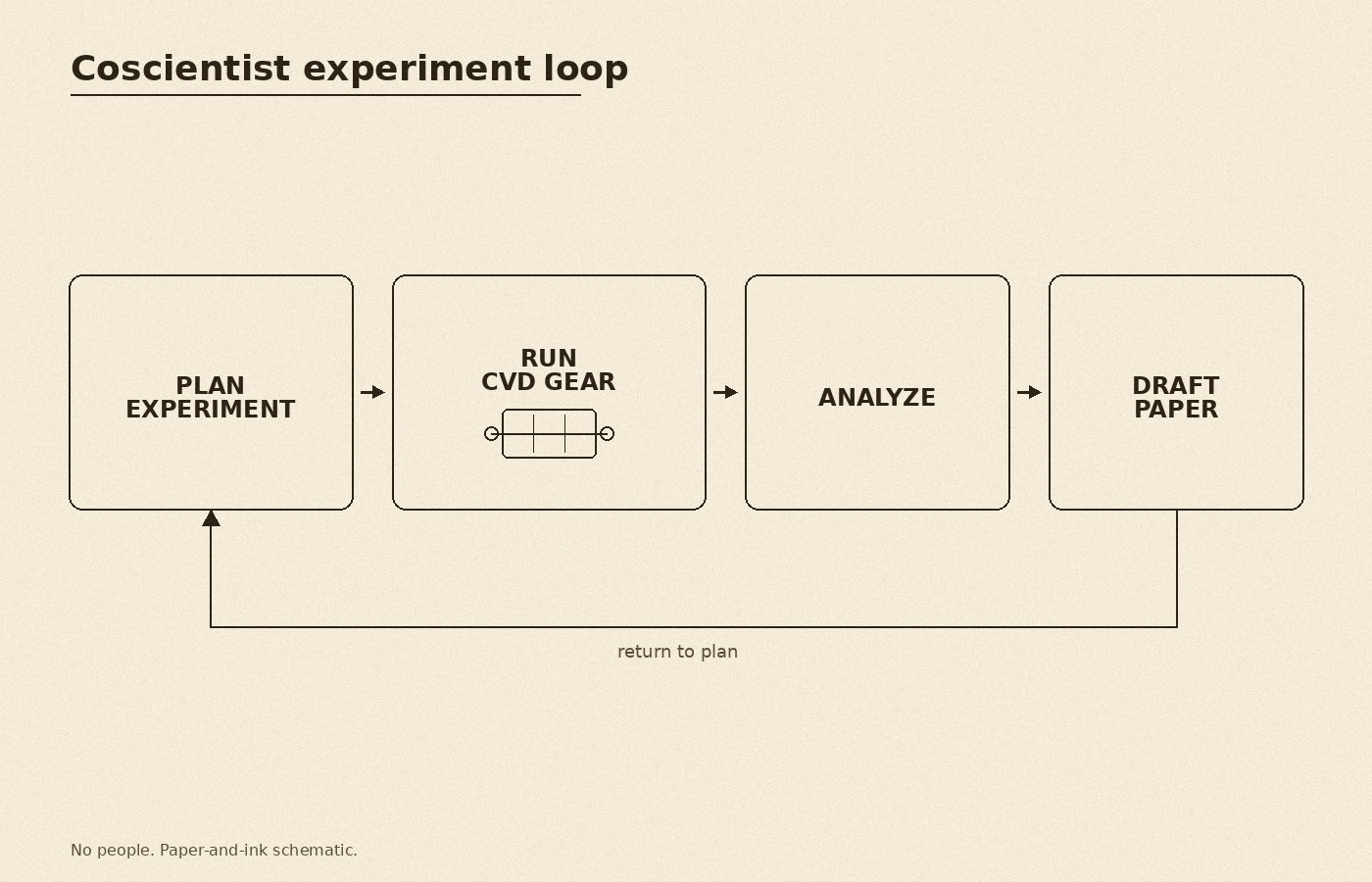
Materials science is where the hardware actually moved. The team wired Co-Scientist to a semi-automated CVD reactor. Per the paper, the system proposed hexachloroethane (C2Cl6) as a safer solid precursor for a Ti3C2Tx MXene that labs usually make with harsh etchants. After 25 rounds, humans refined the recipe, loaded samples, and grew layered 2D crystals that share key structural similarities with that MXene lattice. The authors are blunt: further experiments are needed to confirm the atomic structure. I’m not upgrading that to a discovery.
Separately, with Gemini 3 Deep Think, Co-Scientist tailored growth recipes to that lab’s furnace in minutes and hit first-attempt monolayer MoS2, MoSe2, and WS2. THE DECODER and the paper both keep the human line: operators still loaded precursors and substrates. Fast mode made smaller, less regular crystals than the slow evolutionary search. Whether those recipes travel to another lab is still open.
The 4% is the plot. The physician eval is the caveat.
In biology, Co-Scientist built a vision pipeline that predicted engineered E. coli swarming shapes across IPTG concentrations from sparse images. Predictions matched unpublished wet-lab measurements on three of four morphological metrics, according to the preprint. The authors call it interpolation between known conditions, not a jump into new biology.
On a fully software track, Co-Scientist designed Agent_H, an inference-time medical responder. After length adjustment, it beat six frontier models on HealthBench Hard and Professional. Three board-certified physicians then compared it, blinded, with Gemini 3.1 Pro. The only statistically significant edge was harm reduction. The other eight dimensions were a wash. That’s how both the paper and THE DECODER report the physician eval. Rubric wins are not the same as a doctor preferring the answer.
Then the double-blind study I will actually quote. Thirty domain experts. 450 independent reviews. 150 autonomously generated papers. With reliability modules on, severe result hallucinations — the kind that would invalidate a paper — fell to 4%. Ablate the modules: 46%. The unconstrained Agent Laboratory baseline: 90%. Those three numbers are in the full paper. The safety stack refused 98.7% of hazardous prompts.
I’m not writing that AI scientists replace humans. Physical work still needs a person to load the boat and check the seal. THE DECODER also flags leftover errors: methods that sound plausible but do not match the actual code. Lead author Samuel Schmidgall’s line is the right temperature. There is a long journey before these systems navigate the physical realities of science.
—