From Mexico — I’m reading GitHub’s Project HydraFusion post. It’s a research preview inside Copilot CLI that doesn’t just pick one model. It builds an execution plan: draft, escalate, or critique across providers. Available on all Copilot plans via /experimental, billed at each underlying model’s standard token rate.
VentureBeat nails the framing I wanted. Cost drops on every benchmark GitHub published. “Frontier quality” only clearly holds on one of three. Mario Rodriguez (GitHub CPO) told them Auto picks a model; HydraFusion constructs an execution strategy. Name origin: HyDRA — Hybrid Dynamic Routing Architecture, a Microsoft research paper.
Single, Cascade, Critique
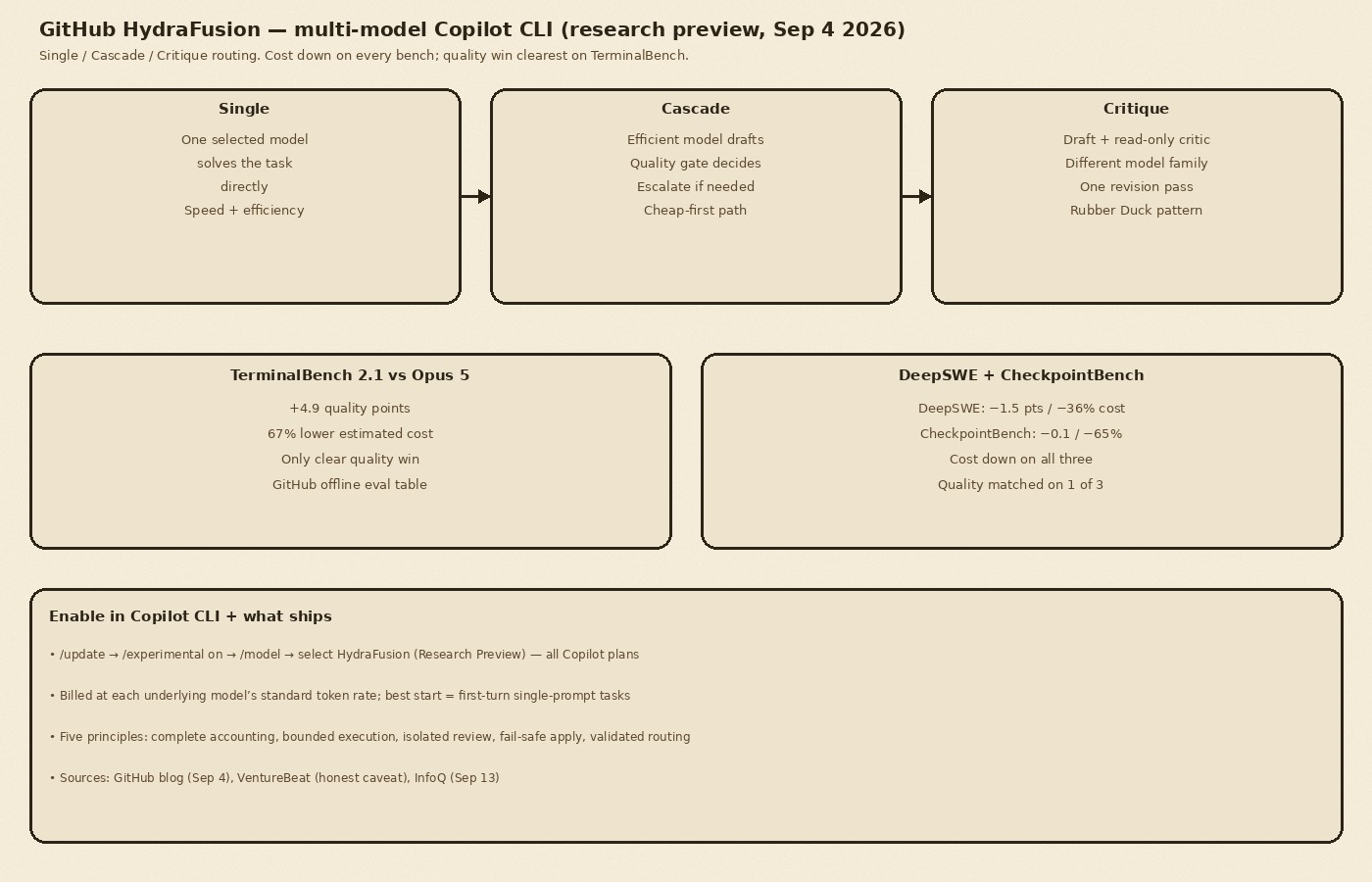
Per the GitHub blog and InfoQ’s Sep 13 writeup, each request gets one of three patterns. Single: one model solves it. Cascade: a cheaper model drafts, a quality gate accepts or escalates. Critique: draft + independent read-only critic from a different family + one revision (Rubber Duck pattern). Routing uses capability signals for reasoning, code generation, debugging, and tool use.
Five operating principles keep that from becoming a mess: complete accounting across every leg, bounded execution with timeouts, isolated tool-less review, fail-safe application (no half-applied patch), and validated routing before run — same stack Stephen W. Thomas walks through for the CLI preview. That’s the boring infrastructure part — and it’s why I’m paying attention.
The honest benchmark table
Controlled offline evals vs Claude Opus 5, from GitHub’s table: TerminalBench 2.1 — +4.9 quality points, 67% lower estimated cost. DeepSWE — −1.5 quality, 36% lower cost. CheckpointBench — −0.1 quality, 65% lower cost. CheckpointBench is GitHub’s internal multi-turn set from real Copilot sessions, anchored to public repos and immutable commits. VentureBeat’s headline is the right takeaway: cheaper every time; quality win only on TerminalBench.
How to try it, from GitHub and InfoQ: run /update, then /experimental on, then /model and pick HydraFusion (Research Preview). Best start today is first-turn, single-prompt coding tasks — multi-turn is still in development. I’m not calling this magic. I’m calling it a cost lever with one clear quality win on the published benches — and that’s worth shipping as news.