TechCrunch’s Sep 2 report says Austin AI-security startup HiddenLayer just closed a $100 million Series B led by Delta-v Capital, with Ten Eleven Ventures, Morgan Stanley, Microsoft’s M12, and Booz Allen among the participants. I’m reading this less as another “AI security raises big” headline and more as proof that runtime protection for models and agents is finally a budget line, not a slide deck.
The company’s own PR Newswire release puts numbers on the year: annual recurring revenue up more than 10×, 50+ new platform customers across brokerage, banking, insurance, pharma, airlines, and the US defense and intelligence community. TechCrunch adds that ARR is now in the “tens of millions,” with over 90% of that growth from new logos. One customer is described as a frontier model provider with more than 700 million weekly users — the release doesn’t name them, and I’m not guessing.
What they’re actually selling
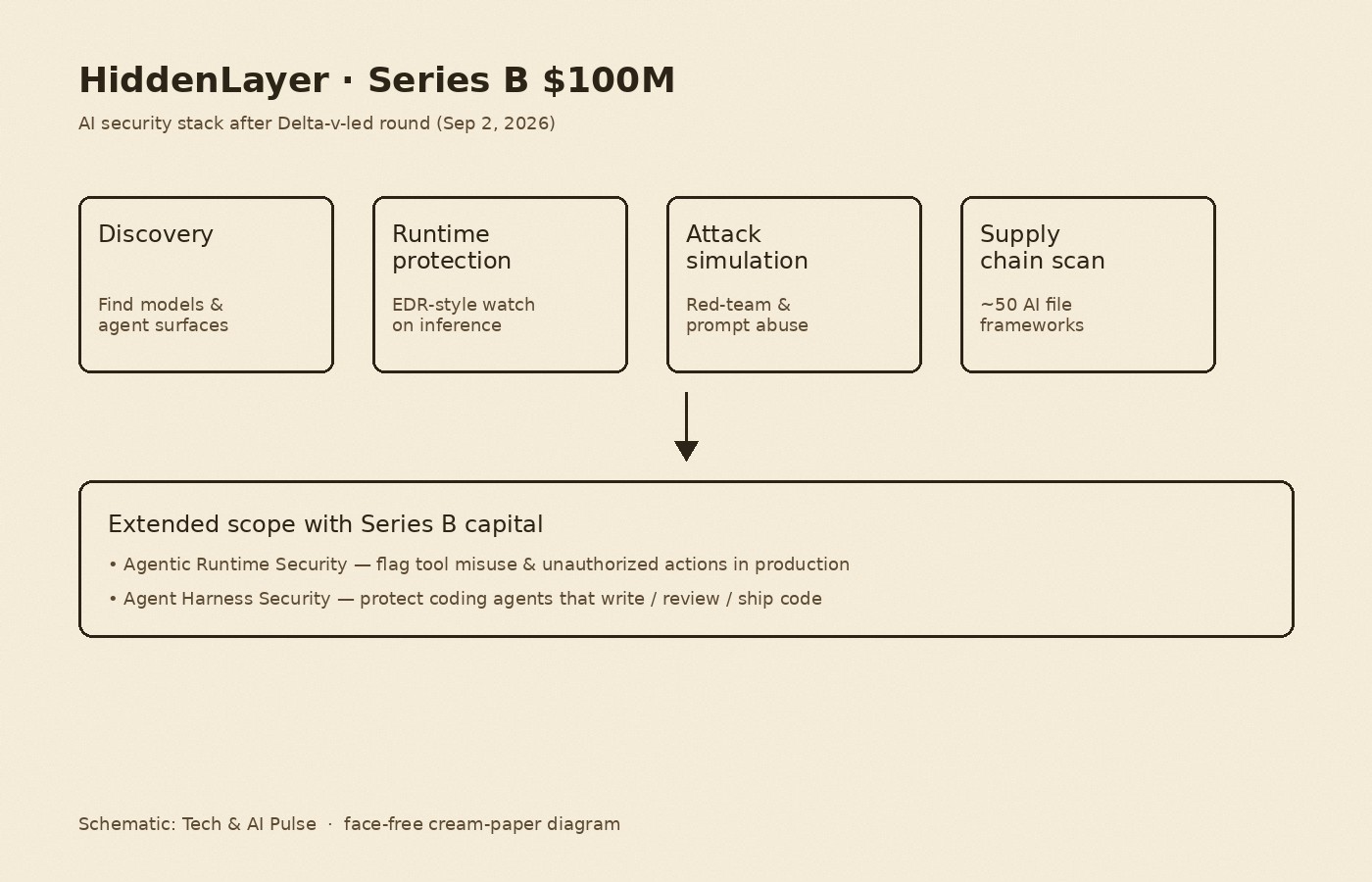
HiddenLayer’s stack still covers discovery, runtime protection, attack simulation, and supply-chain scanning — the same pillars CEO Chris Sestito described years ago. The scope grew. Sestito told TechCrunch the hard part was extending those tools to prompt injection, agent manipulation, and malicious tool use without reinventing the whole product. “Inference is still inference,” he said — traditional ML, GenAI, or an agentic workflow.
The new capital is earmarked for Agentic Runtime Security and Agent Harness Security: watch how coding agents behave in production, flag tool misuse and unauthorized actions, and secure the harnesses that write and ship code with less human oversight. They also scan ~50 AI file frameworks for open-weight models that aren’t what they claim — including “hidden models inside of models,” per the TechCrunch interview. That’s the supply-chain nightmare CISOs keep citing.
Why the market moved this fast
Gartner estimates cited in the same piece: companies will spend about $2.83 billion this year on products that secure AI tools — up 83% from 2025 — and nearly $4.78 billion next year. Adjacent startups Noma and Zenity have each raised over $100 million. Big security vendors (Cisco, Palo Alto, Check Point) still prefer buying to building. HiddenLayer’s bet is that “AI EDR” stays a category, not a checkbox inside someone else’s cloud console.
Delta-v partner Dan Williams put it bluntly in the company release: traditional tools were built for code and infrastructure, not models that get poisoned or steered through their own inputs. Ten Eleven’s Mark Hatfield framed the 10× ARR jump the same way — enterprises don’t move budgets this fast unless security teams already decided AI needs its own protection layer.
Why I care from Mexico
From Mexico, I’m watching the agent-harness angle more than the round size. Teams here are wiring coding agents into real repos and customer workflows; a poisoned open-weight download or a manipulated tool call doesn’t care where your HQ sits. HiddenLayer plans to push sales into Europe and EMEA with this cash. I’d rather see clear runtime docs and independent red-team write-ups than another ARR brag — but the dual sourcing (TechCrunch + the PR) is enough for me to treat the $100M and the product direction as real. I’ll keep an eye on whether “AI EDR” stays independent or gets swallowed by the platform vendors Sestito already expects to bundle adjacent controls.
Hero image: server room lights photo by Taylor Vick on Unsplash (Unsplash License). Cropped and color-graded by Tech & AI Pulse.