From Mexico — I’m watching this one with one eyebrow up. OpenAI says an internal system found a path through the Navier–Stokes existence and smoothness Millennium Prize Problem: an initially smooth fluid at rest can develop a singularity in finite time, with a smooth force and finite energy, establishing Clay statements “C” and “D” (openai.com/index/navier-stokes-solution). That’s a huge claim. It’s also not a Clay award — and CNBC notes the Clay Mathematics Institute hasn’t commented yet.
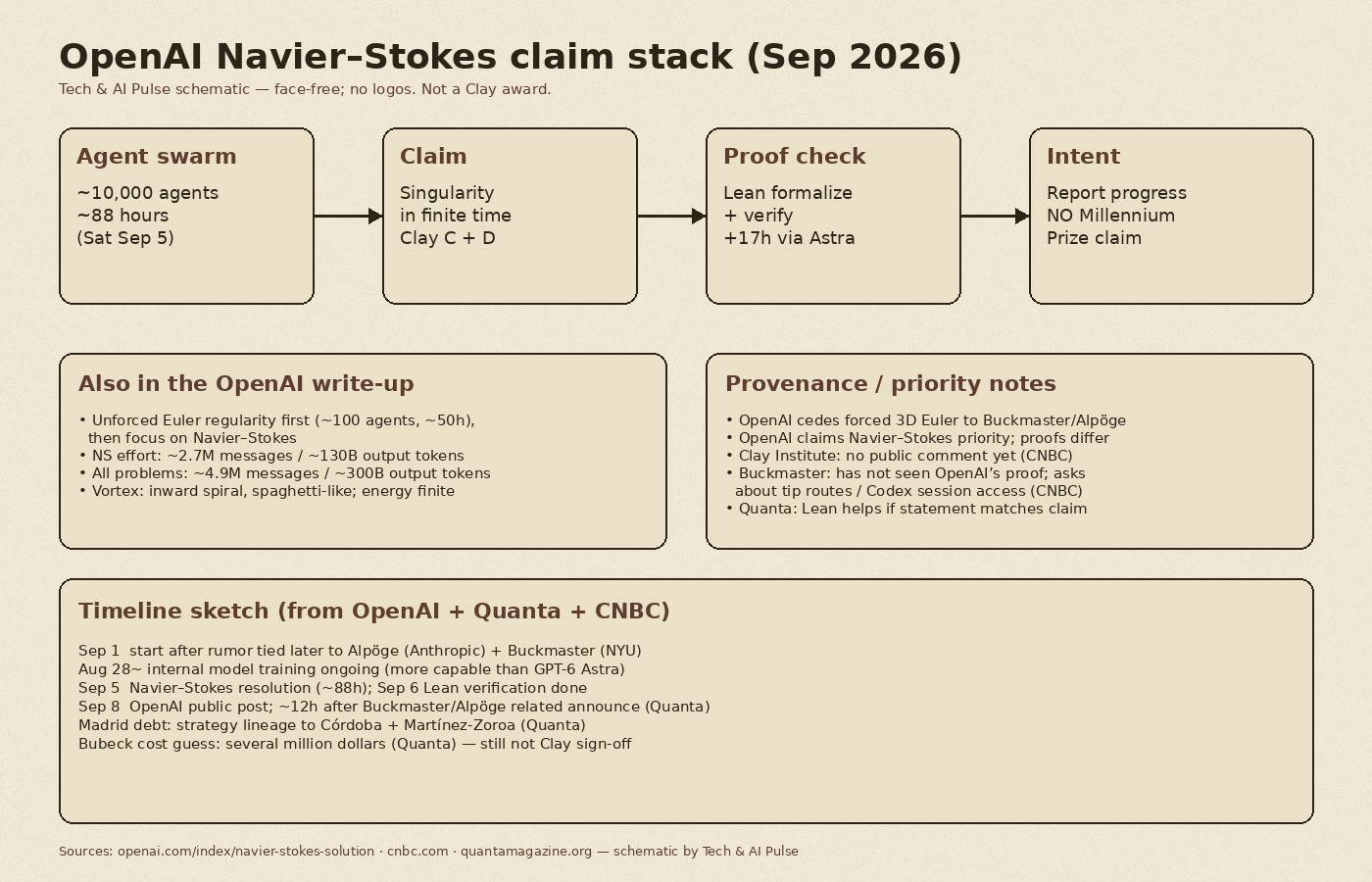
The company pitch is agent swarms with tools (cached internet, code). The group on Navier–Stokes ran on the order of 10,000 concurrent agents. Resolution landed Saturday, Sep 5, about 88 hours after launch. Lean formalization and verification took another ~17 hours via GPT-6 Astra (OpenAI). They say they hit unforced Euler regularity first (~100 agents, ~50 hours), then focused on Navier–Stokes. Across all attempted problems: ~4.9M messages and ~300B output tokens; for Navier–Stokes alone: ~2.7M messages and ~130B output tokens (company post).
What they say the fluid does — and what they won’t claim
OpenAI describes the blowup as a spinning swirl spiraling inward, elongated like spaghetti, while energy stays finite (OpenAI). The internal model is “significantly more capable” than GPT-6 Astra; training has been ongoing since about Aug 28. Goal stated up front: report AI progress. They say they do not intend to claim the Millennium Prize (openai.com). Quanta adds the useful caveat: Lean formalization gives confidence if the formal statement matches the math claim — and that Sébastien Bubeck pegs compute cost in the several-million-dollar range.
Provenance fight: Euler ceded, Navier–Stokes claimed
Effort began Sep 1 after a rumor later tied to Levent Alpöge (Anthropic) and Tristan Buckmaster (NYU). After Lean verification on Sep 6, OpenAI says it reached out and learned those two had forced Euler. OpenAI recognizes Buckmaster/Alpöge priority on forced Euler, says the proofs differ, claims it did not see their work until it was public, and cannot rule out de-identified product-usage data helping models (OpenAI). Quanta notes OpenAI’s announcement came ~12 hours after Buckmaster/Alpöge related results, flags intellectual debt to Diego Córdoba and Luis Martínez-Zoroa (Madrid strategy), and says timeline/provenance details are still murky — OpenAI claims Navier–Stokes priority while ceding 3D Euler.
CNBC quotes Buckmaster: personal collab with Alpöge; tips that progress info reached OpenAI; route similar to theirs; questions about Codex/session access; and “I have not seen OpenAI’s proof.” From Mexico, my read is simple — celebrate the agent-scale claim, keep Clay’s silence in the headline, and don’t pretend the priority fight is settled. Sources: OpenAI Navier–Stokes post, CNBC, Quanta.
Hero image: abstract blue and white swirling liquid art by Logan Voss on Unsplash (Unsplash License). Cropped, graded, and lightly grained by Tech & AI Pulse. Face-free fluid still — no people, no logos.