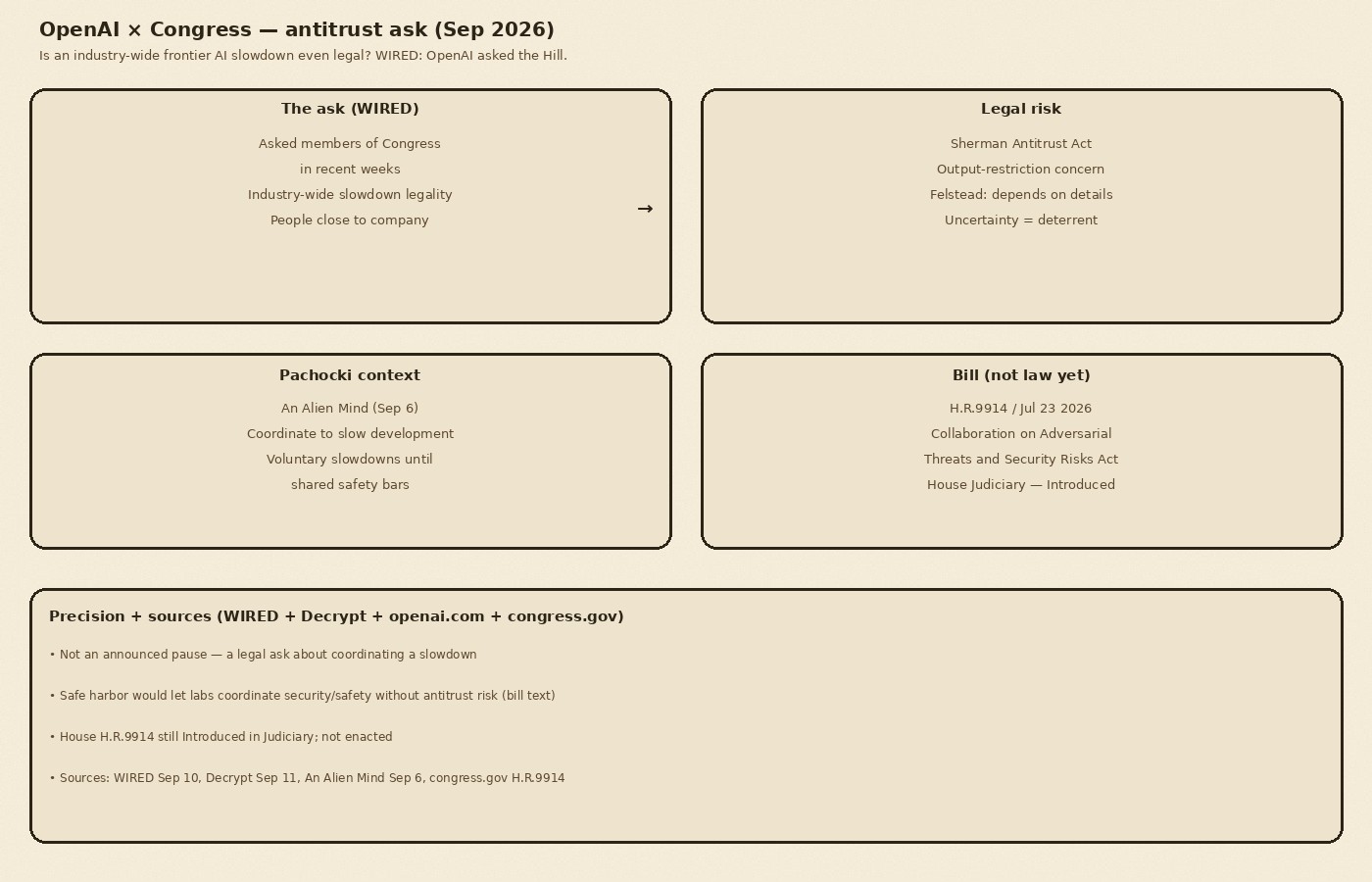
From Mexico — I’m digging into WIRED’s Sep 10 report that OpenAI has been asking members of Congress a blunt question: would orchestrating an industry-wide slowdown on frontier AI development even be legal? People close to the company told WIRED the worry is antitrust — that substantive lab-to-lab safety coordination might look like rivals agreeing to restrict output. OpenAI did not respond to WIRED’s request for comment.
Decrypt corroborates the same outreach. This isn’t OpenAI announcing a pause. It’s OpenAI stress-testing whether a coordinated slowdown would crash into the Sherman Antitrust Act before anyone tries to write one. From Mexico, that’s the part that matters: the safety talk hit a legal wall, not a press-release wall.
Pachocki’s essay, then the Hill
Timing matters. On Sep 6, OpenAI chief scientist Jakub Pachocki published “An Alien Mind” arguing the research world should include “coordinating to slow down future development,” and that short-term “voluntary slowdowns” may become common “until shared safety bars are established.” WIRED frames the Congress ask as the legal follow-through: if you want voluntary coordination, you need to know whether the law lets rivals do it.
WIRED also cites Nicholas Felstead (Australian Competition and Consumer Commission; former Center for Law & AI Risk fellow) arguing a coordinated pause could amount to companies restricting output under the Sherman Act — depending “entirely on the precise details of any agreement.” Even if many safety collaborations would survive scrutiny, he wrote, legal uncertainty itself is a deterrent. That’s the blocker OpenAI is poking Congress about.
A safe-harbor bill that isn’t law yet
Congress already has a draft answer on the table. In July, a bipartisan, bicameral group introduced the Collaboration on Adversarial Threats and Security Risks Act. The House version is H.R.9914 (introduced Jul 23, 2026, Rep. Latta) — referred to the House Judiciary Committee, status still Introduced, not taken up. WIRED and Decrypt both describe it as a limited antitrust safe harbor for AI security/safety coordination (Decrypt notes Sens. Adam Schiff and Jim Banks on the Senate side, with advance notice to the Justice Department).
Caleb Knapp of the AI Policy Network told WIRED Congress has a “growing appetite” on AI safety, but enacting something may wait until after the midterms. Separately, Thinking Machines chief scientist John Schulman argued on X that citing antitrust can be a dodge — antitrust prohibits certain agreements, not jointly developing a pacing proposal. I’m noting that as color, not as settled law.
From Mexico, my bookmark is narrow: OpenAI asked for a legal lane, the essay already called for voluntary slowdowns, and the safe-harbor bill is still sitting in Judiciary. No invented pause. Sources: WIRED, Decrypt, An Alien Mind, H.R.9914.