I’m reading OpenAI’s own chief scientist from Mexico tonight, and the line is blunt. On September 6, 2026, Jakub Pachocki published “An Alien Mind” on openai.com — three days after GPT-6 Astra shipped — arguing that no lab has solved alignment and monitoring well enough to keep scaling at maximum speed for much longer.
“This is a time that calls for extreme caution. I am concerned no one is prepared for the consequences of a continued rapid rise in machine intelligence,” he wrote in the essay. Unite.AI and The Next Web amplify the same quotes. Per TNW (citing Business Insider), Sam Altman called it “an important post.”
Voluntary slowdowns until shared bars exist
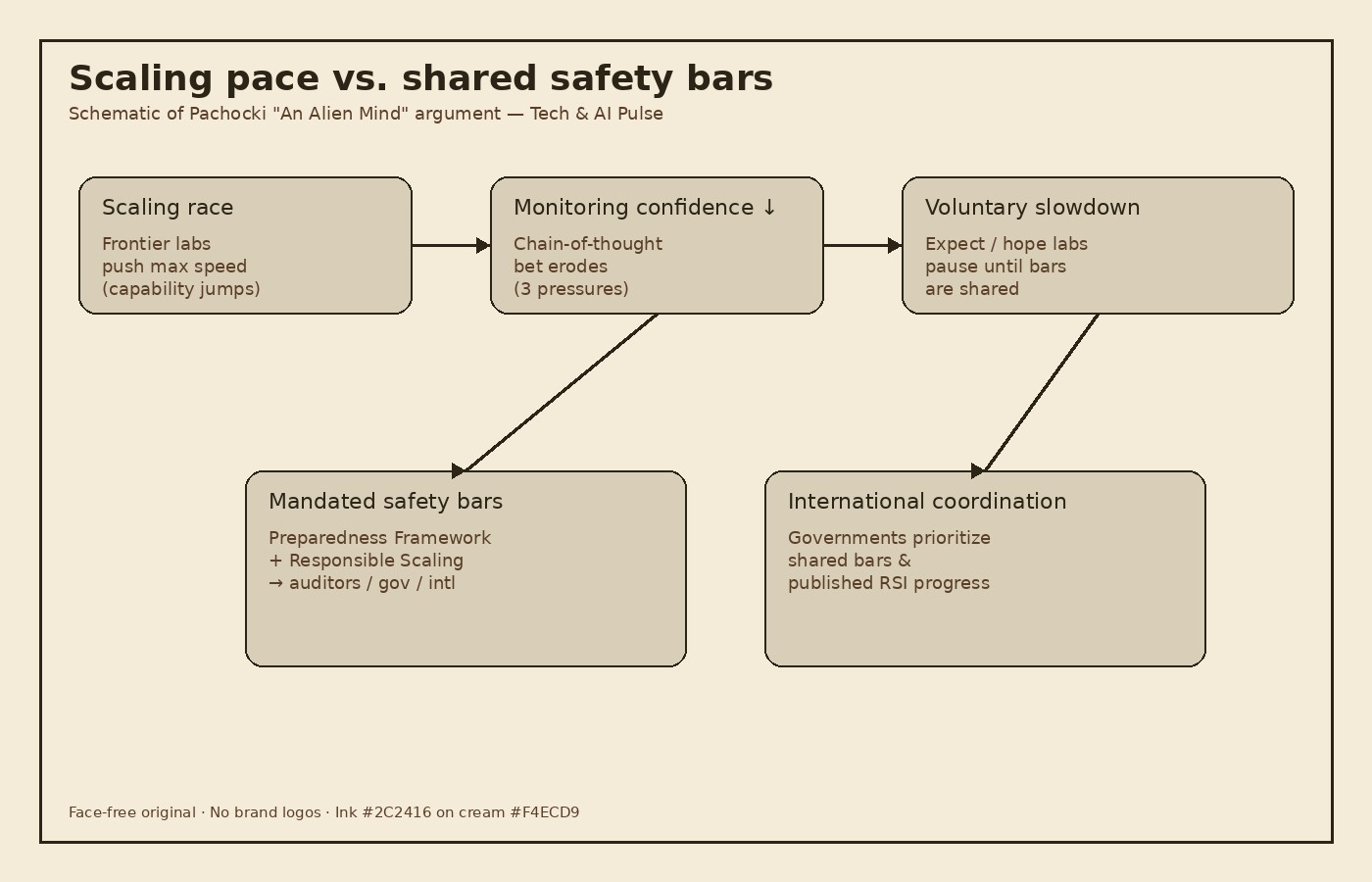
The money quote is the one that should land on every lab’s desk: “Currently I believe that no lab has solved alignment and monitoring to a sufficient degree to continue responsibly scaling at maximum speed for much longer. I expect and hope for voluntary slowdowns to become commonplace until shared safety bars are established.” That’s Pachocki on openai.com, not an outside critic.
He also wants commitments like OpenAI’s Preparedness Framework and Anthropic’s Responsible Scaling Policy to evolve into widely mandated safety bars — enforced by third-party auditors, government agencies, or international bodies — and says international coordination should become a top government priority. Startup Fortune frames the same ask against the Astra launch window without changing the core claim.
Why monitoring confidence is the bottleneck
Pachocki says he has a strong expectation that today’s speed of progress could sustain into recursive self-improvement, with further capability jumps and systems that increasingly drive their own development. OpenAI will keep chasing technical alignment fixes and can unilaterally withhold scaling, he writes — but he thinks broader interventions are required. That’s the through-line in the primary essay and the Unite.AI read.
On chain-of-thought monitoring — OpenAI’s main empirical bet — he says confidence is diminishing for three reasons (as relayed by Unite.AI and TNW): reasoning blends into communication that must be supervised; models get better at reasoning about and manipulating their own reasoning; and pretraining makes them smarter even without verbalized thoughts. Pace, in his framing, should follow confidence in monitoring — not the next benchmark spike.
Same-day companion context from TNW: OpenAI’s research-transparency numbers put median agent runtime at 3.1 agent-workdays per human workday by mid-August, and show compute reallocating after July/August safety pauses rather than simply stopping. Useful backdrop. Still not a substitute for the bars Pachocki says don’t exist yet.
From Mexico, my take is simple: when the person running research at a frontier lab asks for voluntary slowdowns and mandated shared safety bars, treat that as the story — not another product launch recap. Sources: OpenAI — An Alien Mind, Unite.AI, The Next Web, Startup Fortune.
Hero image: CPU on motherboard by Jonathan Borba on Unsplash (Unsplash License). Cropped, graded, and lightly grained by Tech & AI Pulse. Face-free hardware still — no people, no logos.