
Friday’s drop from Tencent Hunyuan is the kind of open-weights news I actually bookmark. On Aug 28, 2026, they released Hy4 preview: a Mixture-of-Experts model with 770B total parameters and about 49B active per token, plus a context window over 1M tokens. Weights are Apache 2.0 on Hugging Face (also ModelScope and GitCode), and you can hit it through APIs too.
I’m reading this as a productivity-first coding model, not another vague “general chat” launch. Tencent’s own post frames Hy4 for software engineering, office work, game prototyping, and research — and they co-designed it with products like CodeBuddy and WorkBuddy.
What’s actually in the box
The Hugging Face card is clear on the shape: MoE backbone, 78 layers, top-8 routed experts plus a shared expert per token, and a native MTP layer for speculative decoding. Context length is listed at 1M. License is Apache 2.0 — commercial-friendly, no field-of-use drama on the card.
Access paths from the official release: try it inside WorkBuddy and CodeBuddy (also Yuanbao and ima), or call it via Tencent Cloud TokenHub and OpenRouter. API list price in the Tencent post: about $0.834 per million input tokens, $2.501 per million output, and $0.042 per million for cache hits.
Company-reported scores — treat them that way
Tencent says an internal blind eval with 163 experts and 203 engineering tasks put Hy4 at 2.99 / 4.00, slightly ahead of GLM-5.3 (2.92) and Kimi K3 (2.94). Same company post claims the model helped tune its own inference path and lifted end-to-end throughput by 31.8% versus their baseline. Those numbers are company-reported — I haven’t seen an independent re-run published yet, so I’m filing them as Tencent’s own readout, not settled leaderboard truth. Byteiota makes the same caveat on the broader bench sheet.
Preview caveats I’d keep in mind
This is labeled a preview. The HF card is honest about known issues: it can spend longer than it needs reasoning through hard tasks, and it tends to over-verify its own work. That’s latency you feel on simple prompts. The card’s tip (also covered by Byteiota): for direct answers, pass reasoning_effort: "no_think" via chat_template_kwargs instead of the default deep thinking mode.
How I’d try Hy4 this week
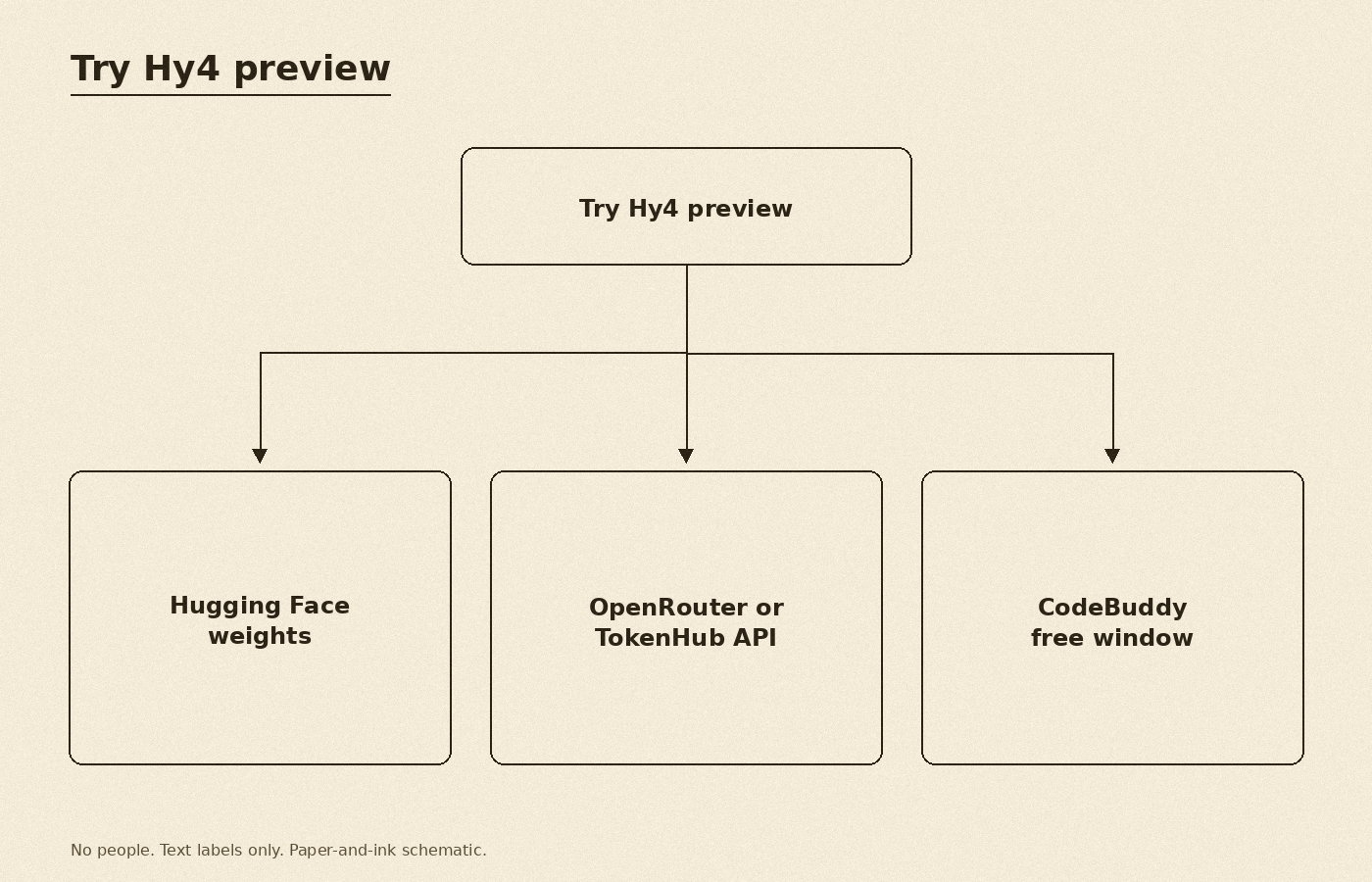
1. Free product window first. Tencent says Hy4 is free on WorkBuddy and CodeBuddy for two weeks from the Aug 28 launch — so you’re looking at a short trial window into early-to-mid September, not an open-ended promo. I’d open CodeBuddy, throw it a real multi-file bug or a long-context refactor, and see if the planning/debug loop feels sticky.
2. API if I want it in my own tools. OpenRouter or TokenHub gets you an OpenAI-compatible path without racking GPUs. At those input/output rates, I’d start with a few agentic coding jobs and watch cache-hit pricing if I’m reusing big system prompts.
3. Weights if I’m evaluating self-host later. Grab tencent/Hy4-preview (or the FP8 sibling the card points at for serving). The HF quickstart shows vLLM / SGLang Docker recipes with tensor parallel size 8 — I’m not inventing a VRAM shopping list here; I’d follow their recipe docs before I budget hardware.
Bottom line for me: open weights + a short free product window + sane API pricing is a solid try-this-weekend combo. Just remember it’s a preview — company benches, over-thinking latency, and all — and keep that no_think switch handy when you don’t need a novel on every reply.