From Mexico — I’m covering Google DeepMind’s AlphaGenome Atlas. The pitch is blunt: there are about 9 billion possible single-letter changes in the human genome. You can’t wet-lab each one. So they precomputed AlphaGenome’s molecular-effect predictions at that scale and shipped a searchable map.
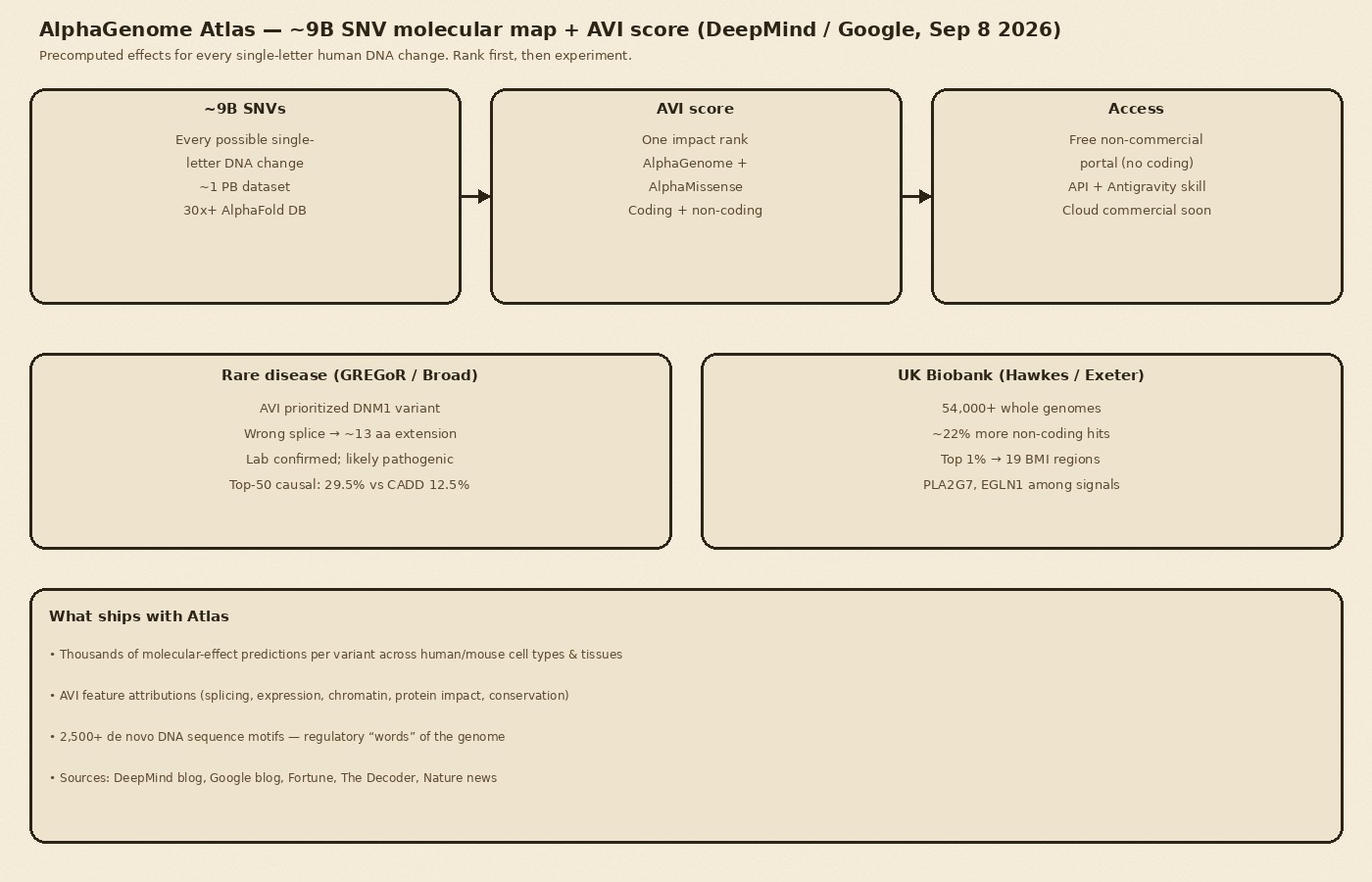
Google’s launch note calls it a ~1-petabyte dataset — DeepMind says more than 30× the AlphaFold Database. Researchers get thousands of effect predictions per variant across cell types and tissues, not a one-off API call every time they wonder about a SNP.
One number: the AVI score
Thousands of numbers per variant is noise for a clinic. So DeepMind also ships the AlphaGenome Variant Impact (AVI) score — one rank that folds AlphaGenome’s regulatory/splicing picture together with AlphaMissense for protein-altering changes. Per the DeepMind blog, it covers both the coding 2% and the non-coding 98% where most trait-linked variants sit.
Fortune’s writeup gives the scale I wanted: AVI 10 ≈ top 10% most impactful; AVI 30 ≈ roughly the strongest one in a thousand. Scores break down into drivers — splicing, expression, protein change — so you’re not staring at a black box rank.
Rare disease and Biobank proofs
This isn’t only a dump of tensors. With the GREGoR consortium, Broad’s Laura Covill and Anne O’Donnell-Luria used AVI on unsolved rare-disease cases. Per DeepMind and Fortune, Atlas pushed a previously unclear DNM1 variant (epileptic encephalopathy) — wrong splice site, ~13-amino-acid protein extension on a brain isoform. Lab work confirmed it; the call moved toward likely pathogenic.
On already-solved GREGoR cases, The Decoder and Fortune both cite the paper’s retrospective: AVI put the causal variant in the top 50 candidates 29.5% of the time, versus 12.5% for CADD. Different tool, same needle-in-haystack job — that gap is why I’m writing this.
On the population side, Exeter’s Gareth Hawkes ran Atlas against whole genomes from 54,000+ UK Biobank participants. Google says grouping rare variants by predicted molecular effects surfaced about 22% more non-coding associations. Focusing on the top 1% most impactful non-coding variants flagged 19 BMI-linked regions; DeepMind also names proteins like PLA2G7 and EGLN1 in the longer technical post.
How you actually open it
Access path from the DeepMind post: non-commercial website portal (no coding required), AlphaGenome API, and a skill inside Google Antigravity. Commercial use is lined up on Google Cloud. The base AlphaGenome model was already out for academic use (GitHub / API) and on Cloud Model Garden for commercial work — Atlas is the precomputed map on top. Nature’s news piece frames the same launch for the research audience.
I’m not claiming Atlas “solves” genetics. It’s infrastructure: rank first, then experiment. If you triage variants for rare disease or noisy biobank signals, this is the release to bookmark — and to check against your own CADD / ClinVar habits before you trust the score alone.