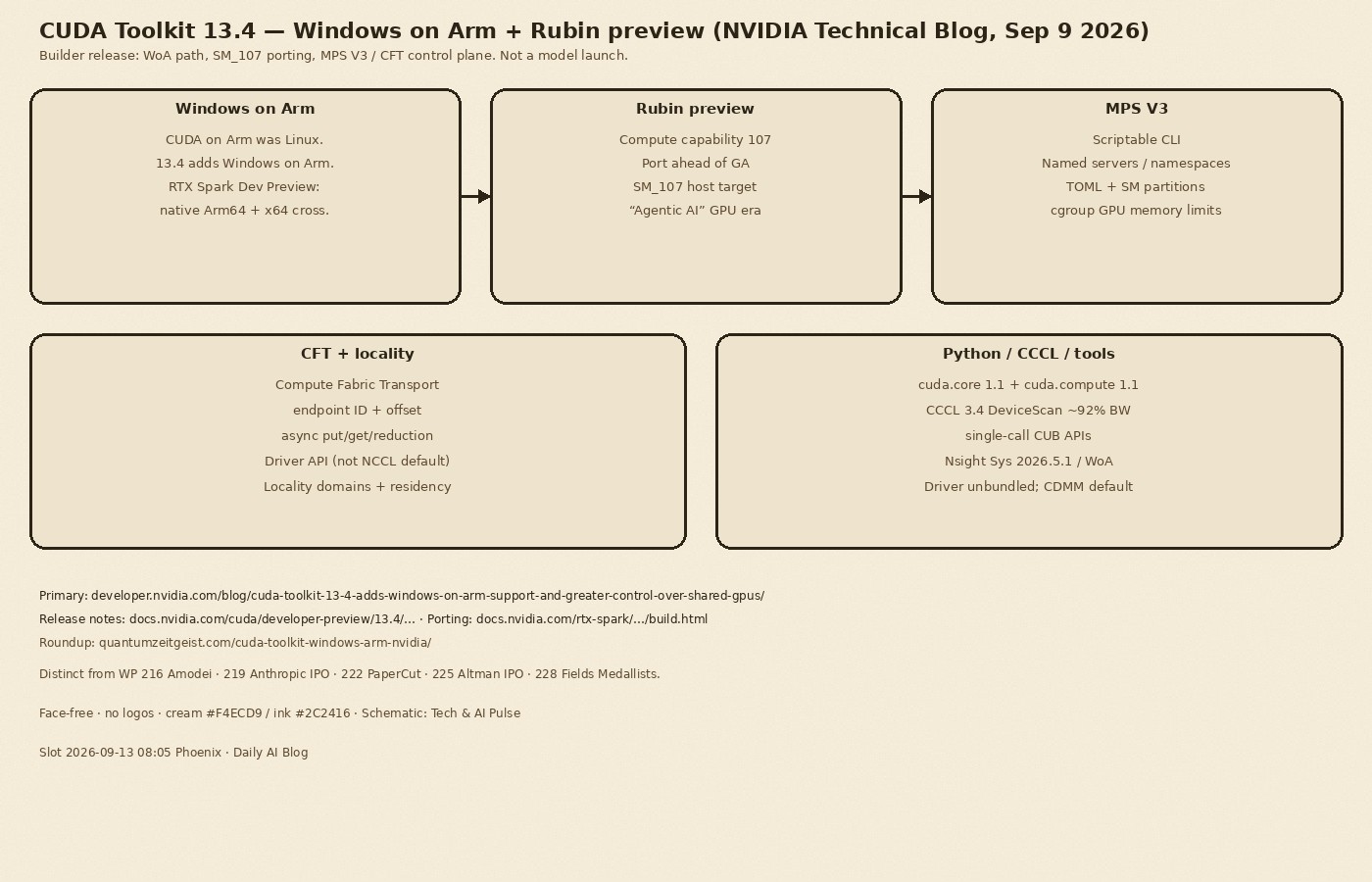
From Mexico — Sunday morning I’m reading NVIDIA’s note on CUDA Toolkit 13.4. The headline that stuck: CUDA on Arm isn’t Linux-only anymore. This release adds Windows on Arm. And if you’re chasing the next GPU generation, there’s preview support for NVIDIA Rubin (compute capability 107) so you can start porting before general availability.
The 13.4 Developer Preview release notes frame the Windows Arm64 work around RTX Spark — native Arm64 installs and cross-compiles from Windows x86_64. NVIDIA’s Windows on Arm porting guide walks the CMake / Visual Studio bits. I’m treating that as the builder path, not marketing.
Rubin preview, not GA theater
On the NVIDIA Technical Blog, Jonathan Bentz says 13.4 adds functional support for Rubin as a preview. NVIDIA’s line: Rubin is the next-generation GPU architecture “powering the era of agentic AI.” Host compiler support now includes GCC 16 and Clang 22, with an SM_107 target for Rubin. That’s the practical bit — you can compile toward the new arch before the full stack is generally available.
Sharing GPUs without the old MPS pain
Multi-Process Service gets a real control-plane bump. Per the same blog, MPS V3 adds a scriptable CLI, named server instances, namespaces, TOML config, SM partition controls, and cgroup-integrated GPU memory limits. The point is precise partitioning in containers — performance, memory boundaries, and priority defined in software instead of hope.
There’s also CUDA Compute Fabric Transport (CFT) for people building communication libraries. Instead of mapping every remote GPU allocation into a process’s virtual address space, you target named logical endpoints (endpoint ID + offset) and fire async put/get/reduction across NVLink fabric. NVIDIA is clear: CFT is a Driver API for specialized libraries; most of us should keep using NCCL or NVSHMEM.
Python, CCCL, and the fine print
cuda.core 1.1.0 expands texture/surface programming, NUMA-aware managed memory, and ships .pyi stubs. cuda.compute 1.1 adds ahead-of-time compilation of CCCL algorithms for multiple architectures — including on build boxes without a GPU. CCCL 3.4’s warp-specialized cub::DeviceScan on Blackwell is the number I’m watching: NVIDIA shows up to about 92% memory-bandwidth utilization, up from roughly 50% on the prior path. There’s also a single-call CUB API style and cuda::std parallel algorithms with cuda::execution::gpu.
Other details from the official post and release notes: locality domains, unified-memory residency queries via cudaMemGetLocationInfo, toolkit installers that no longer bundle the driver, and coherent platforms (Grace Hopper, Grace Blackwell, Vera Rubin) defaulting to Coherent Driver-based Memory Management instead of NUMA. Nsight Systems 2026.5.1 covers CUDA 13.4, Rubin, and Windows on Arm. Core math libraries pick up Rubin functional support and Windows on Arm for the N1X laptop ecosystem. Quantum Zeitgeist has a same-day roundup if you want a secondary walk-through.
I’m not pretending this is a model launch. It’s toolkit work — the boring layer that decides whether agentic stacks actually run on the hardware you buy. If you’re shipping CUDA on Windows Arm boxes or prepping for Rubin, 13.4 is the download to try this week.