Meta Superintelligence Labs’ Sep 2 post drops Muse Spark 1.3 — rolling out today in Muse Code and the Meta Model API. I’m less interested in another “most powerful yet” line and more in the builder claim: longer-horizon agents that thrash the tools less.
Bloomberg’s same-day write-up says developers can access and pay for 1.3 on Wednesday, with the update later rolling toward Meta’s social apps and Meta AI. Wikipedia’s Muse Spark page already lists 1.3 as the stable release dated September 2, 2026 — useful as a third timestamp, not as a product deep-dive.
What actually shipped today
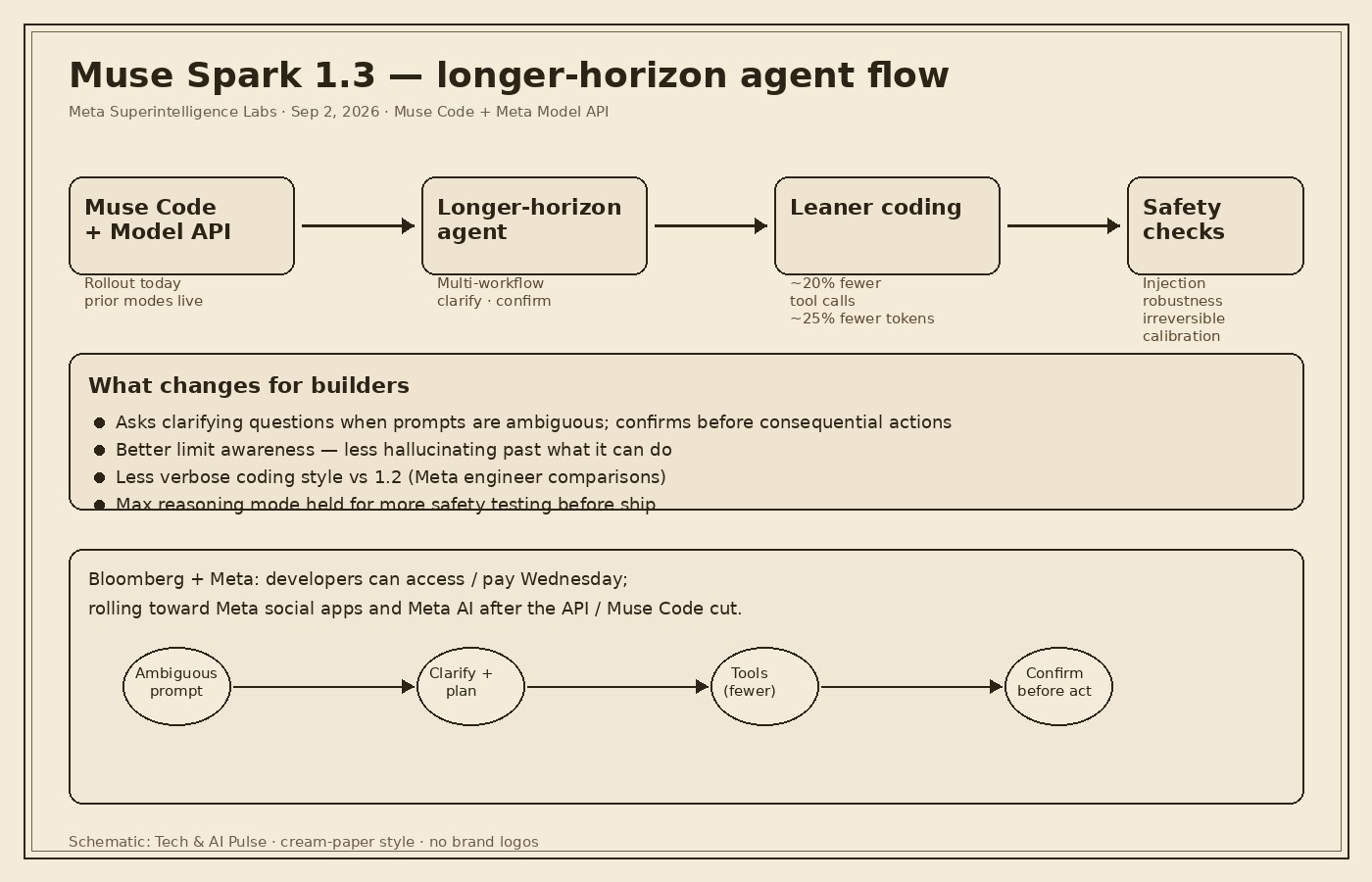
Per the Meta research blog, previously available reasoning modes are live now; max reasoning comes after more safety testing. The agent pitch is concrete: sustain longer-horizon work across multiple workflows in one thread, ask clarifying questions when prompts are fuzzy, pull the user in when stuck, and confirm before consequential actions. Better limit awareness is the quiet part — knowing what it can’t do instead of hallucinating past the wall.
On coding, Meta says 1.3 was trained on more long-horizon engineering workflows. Versus Muse Spark 1.2, internal engineer comparisons claim ~20% fewer tool calls and ~25% fewer tokens, with less verbosity and a cleaner style. That’s the “cuts the tool thrash” bit for me — fewer round-trips before the deliverable lands.
Safety and the wait on max reasoning
The same Meta post claims stronger adversarial robustness and better resistance to prompt injections, plus tighter calibration on irreversible agentic actions. Holding max reasoning until safety testing finishes is the grown-up move — I’d rather wait than get a mode that ships loud and breaks quiet.
Bloomberg frames 1.3 as Meta edging closer to top competitors, with chief AI officer commentary on capabilities. I’m treating the public Bloomberg takeaways plus the Meta blog as the dual source of truth; the paywalled depth can wait.
Why I care from Mexico
From Mexico, I’m watching the Muse Code / Model API cut more than the social-apps rollout. Teams here already wire coding agents into messy repos; fewer tool calls and clearer confirms before consequential actions matter when your latency and token bill aren’t Silicon Valley monopoly money. The Muse lineage (1.1 → 1.2 → 1.3) is Meta’s bet on agentic coding after Llama. I’ll believe the ~20%/~25% efficiency numbers when third-party evals land — but the ship date, the Muse Code + API path, and the max-reasoning hold are already on the record via Meta and Bloomberg.
Hero image: macro circuit board photo by Alexandre Debiève on Unsplash (Unsplash License). Cropped and color-graded by Tech & AI Pulse.